Transformation of former post office into learning centre
- Education
- Private
- Completed
- Location
Louvain-la-Neuve
- Surface
800m²
- Client
CPFB - Centre d'enseignement supérieur de Promotion et de Formation continuée en Brabant Wallon
- Partners
aaia, MATRIciel, Cosep, CBD
- Description
Restoration, renovation and transformation of the former post office in Louvain-la-Neuve
The “Centre d’enseignement supérieur de promotion et de formation continuée en Brabant wallon” (CPFB), affiliated with UCL, brings together around one hundred professors and experts across a wide range of educational activities. In March 2018, the CPFB launched a competition to transform the former post office into a learning centre, with one central question: how can this place be adapted to new teaching methods and the diversity of educational programmes?
participatory programming
Places for use, not for functions
The institution is diverse in its courses, profiles, timetables and group sizes. Together with users, we therefore defined a project that embraces this diversity. Traditionally, the logic is:
PLACE = FUNCTION = USE
To support new learning methods, we abandon this fixed link between place and function. Functions become mobile; people move according to the activity. We create spaces with a strong character, designed for a specific mode of use rather than a fixed function:
PLACE = USE, FUNCTION IS MOBILE
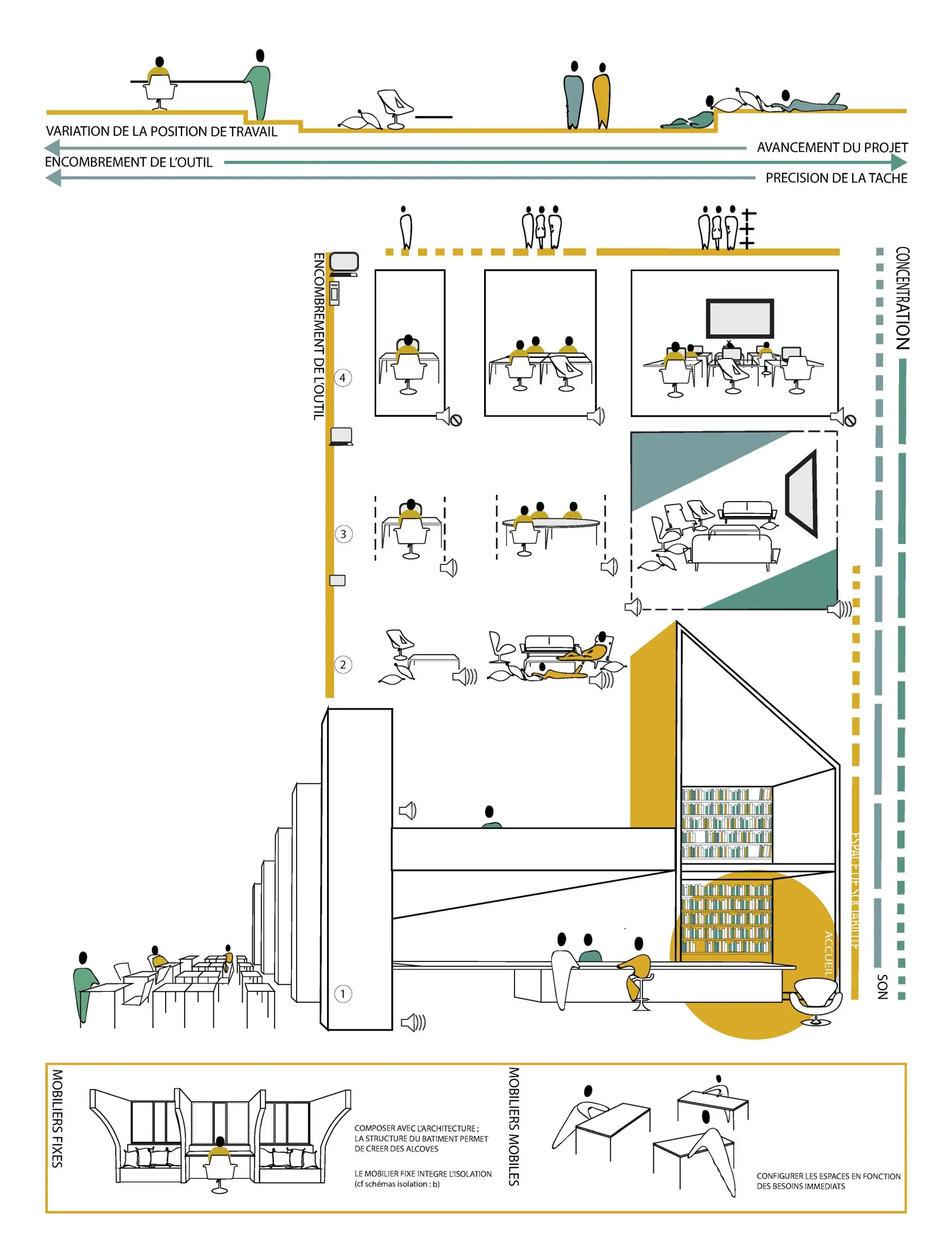
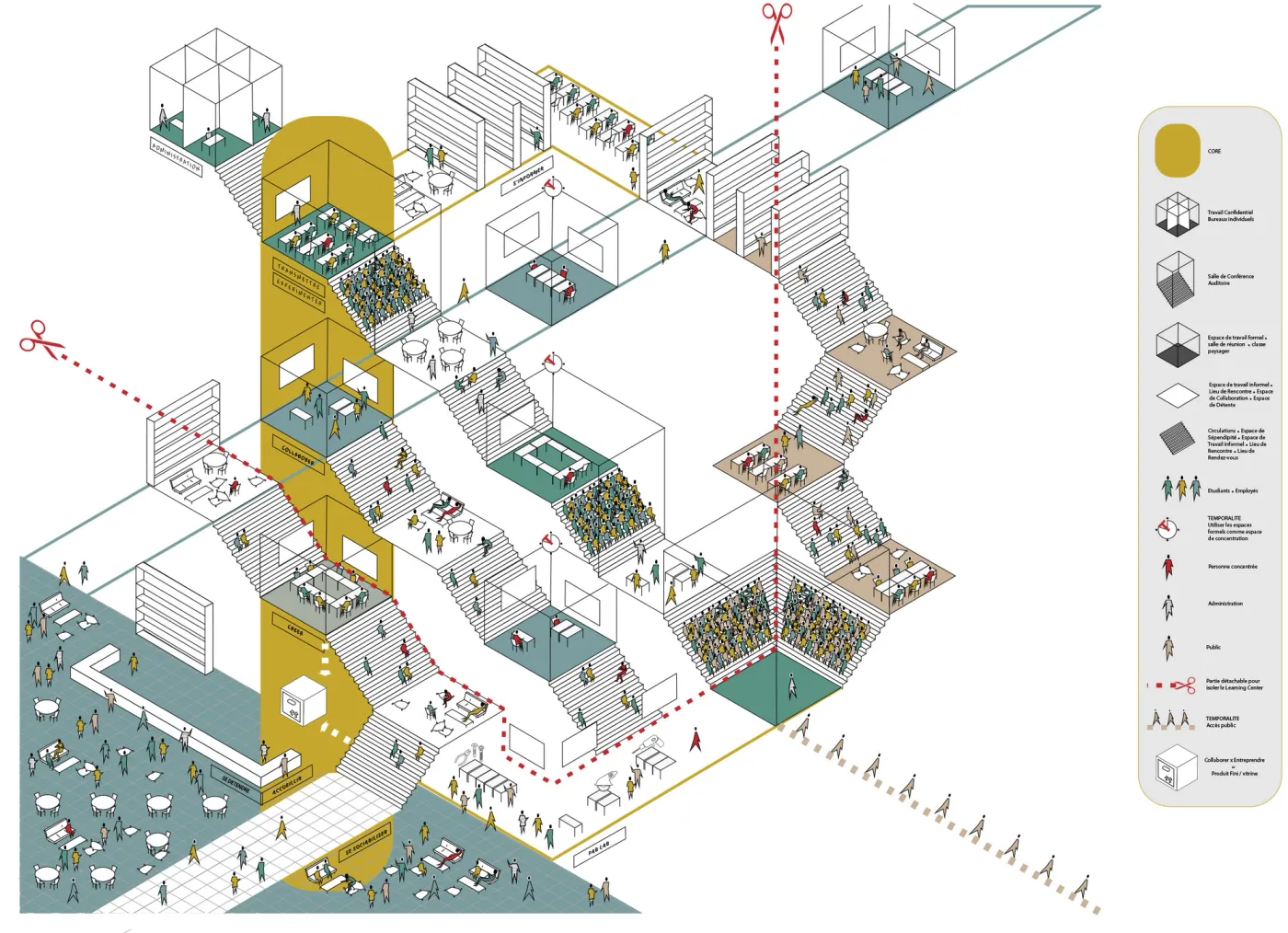
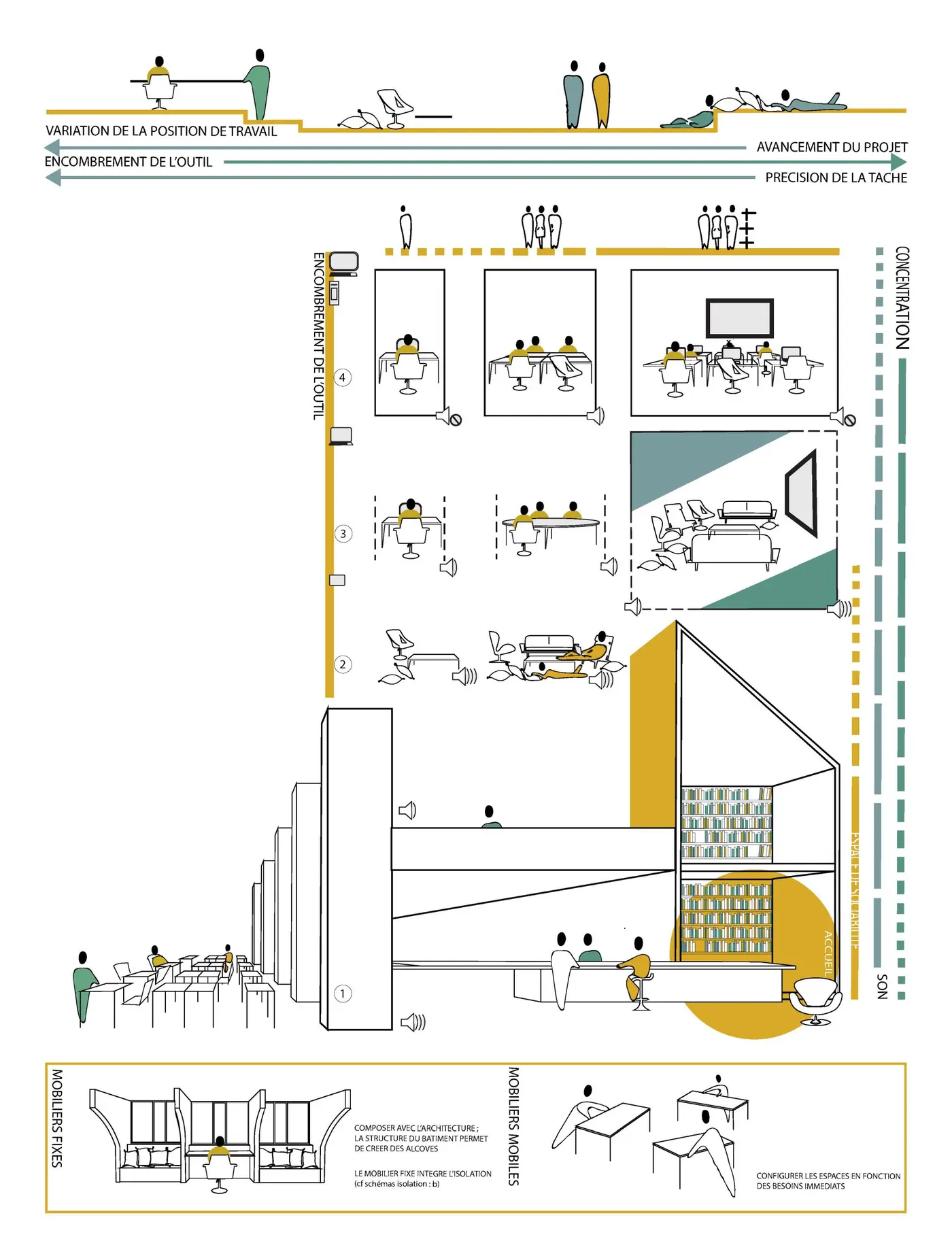
Visualisation of the different zones in the building – ergonomics, social interactions, acoustics.
Auditorium. Copyright archipelago
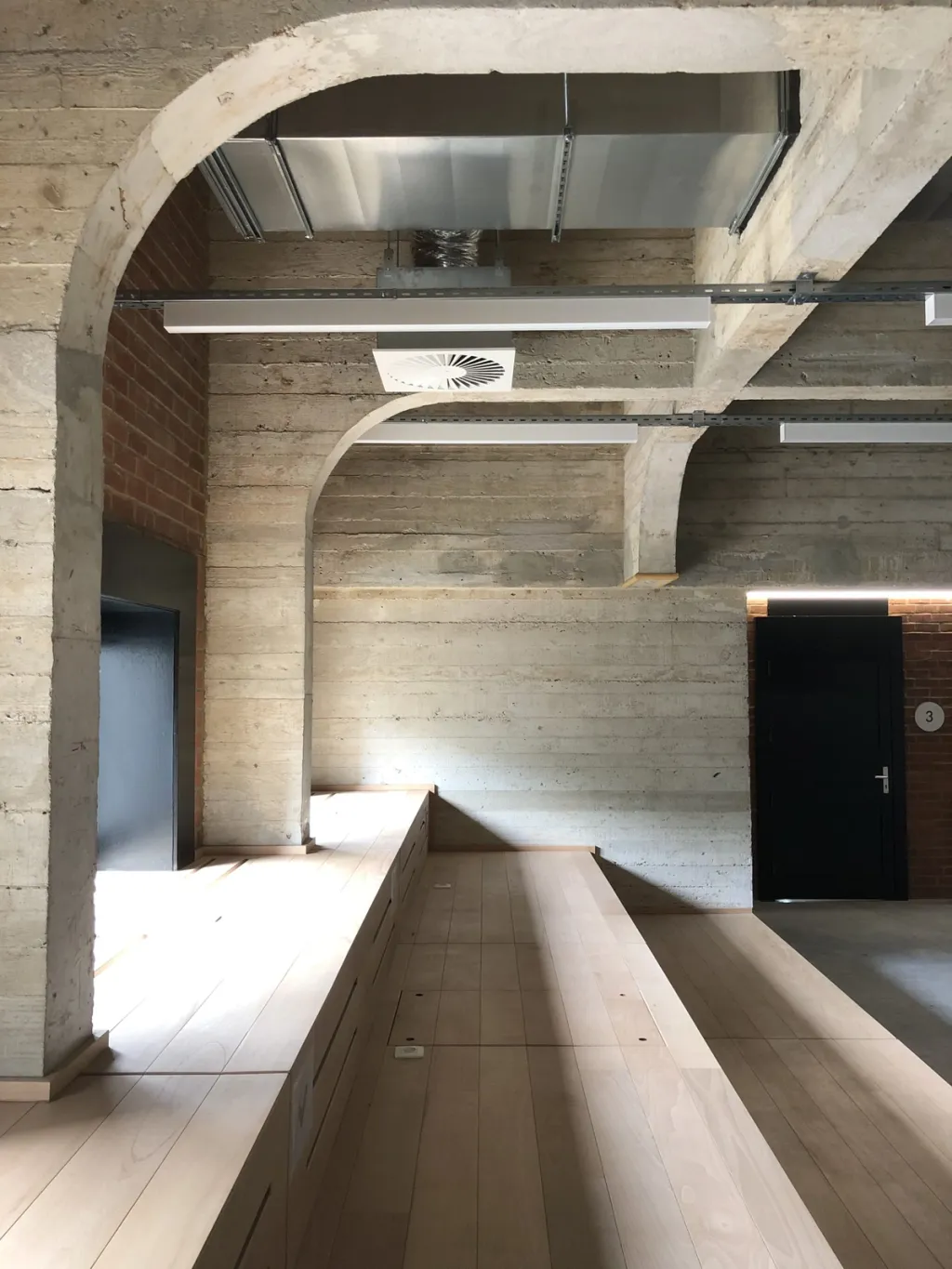
Participatory programming
In collaboration with the CPFB, we examined the different uses in detail to define the optimal setting (quiet/noisy , formal/informal, individual/group, large/small, confidential/open, fixed/mobile) and studied ergonomics to determine appropriate spaces and furniture. Participatory programming is essential: users do not always know exactly what bothers them, but they are experts in their work and habits.
Through three workshops with administration, management, lecturers and students, we collected and analysed information, validated space typologies and structured the organisation and relationships between the various zones. On this basis, the actual activity-based design could begin.
Zoning of the different spaces
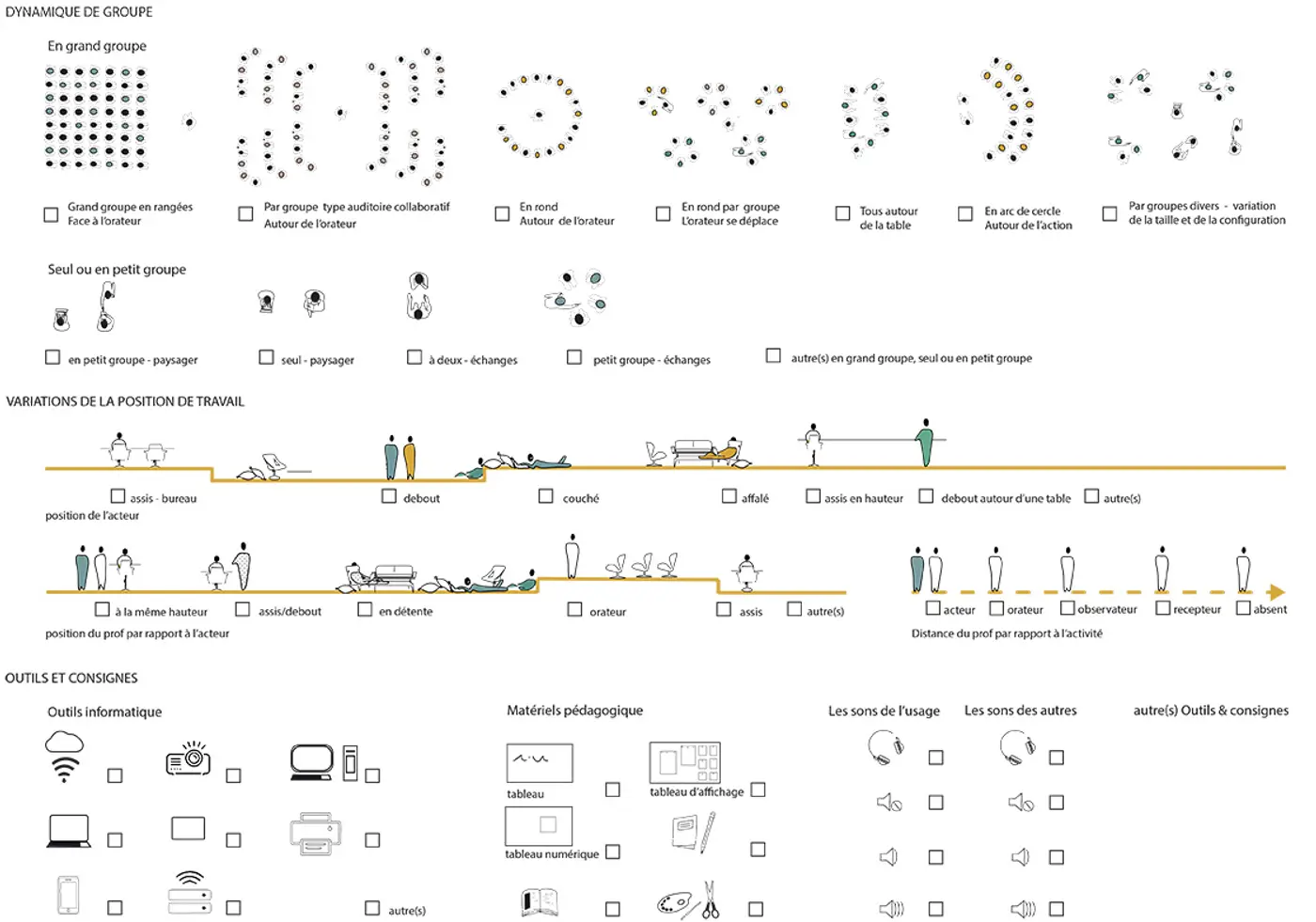
A thoughtful renovation: revealing the original structure
The building has had several lives: from post office to UCL teaching facility and later a “school of sound”. Partitioning and acoustic interventions had erased the simplicity of spaces and materials.
The project restores openness by revealing the original structure: heights, volumes and materials. The building was first stripped back: concrete preserved, brickwork cleaned, joinery repaired. The play of daylight through the glass roof blocks onto the beam structure becomes visible again. Circulation is simplified and a large open area at the rear is transformed into a seating zone.
A thoughtful renovation: thinking ahead
The aim is to restore the building as close as possible to its original state while preparing it for the future. The east façade is opened up to connect the ground floor more directly to the outside space. On the ground floor, a social, open area with reception leads into a multifunctional zone with work alcoves and workspaces. On the upper level, there are collaborative spaces, auditoria, a lab, administrative offices and a recording studio.
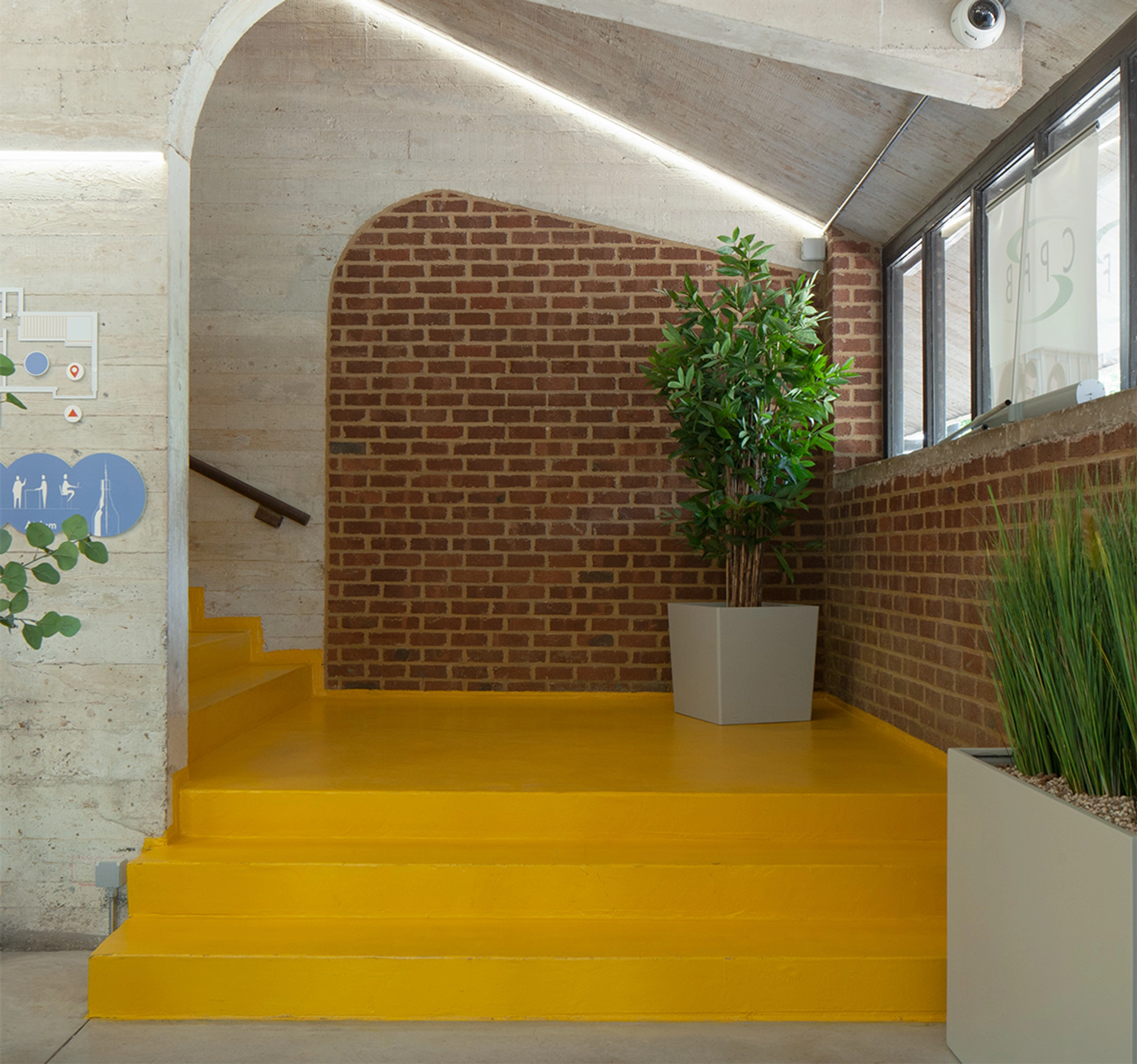
Once the materiality and volume had beenrestored , a smooth concrete screed floor was poured to emphasise the robust character. Graphic accents reinforce this: lighter new joinery contrasts with the darker existing elements, and the yellow staircase stands out against the red brickwork. These contrasts highlight the inherent qualities and bring the building back to life.
“By exposing the original structure, contrasting zones emerged in which old and new reinforce one another.” Sophie Laborde, architect
The old brick and concrete structure is exposed and complemented by a yellow staircase. Copyright Johnny Umans
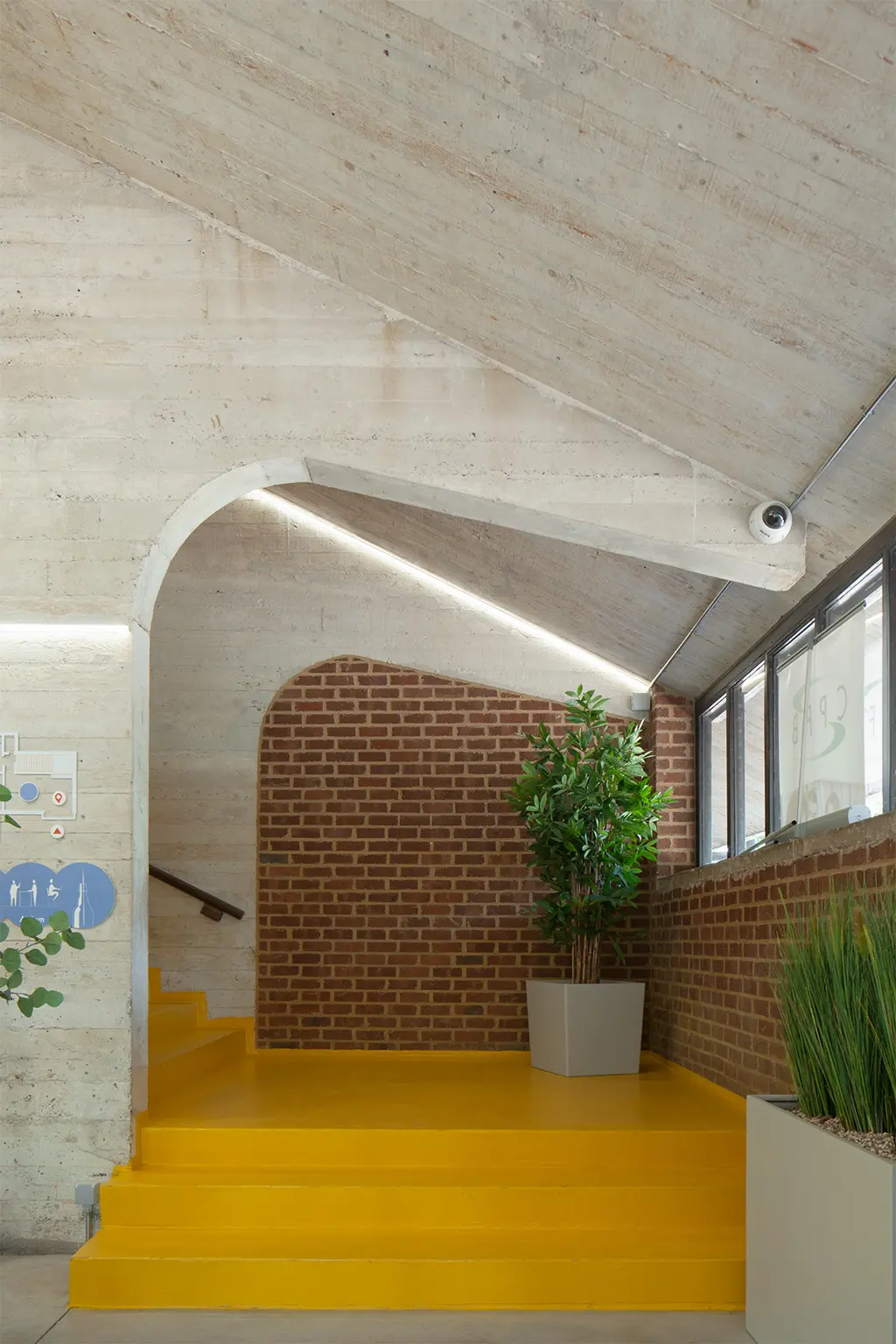
Contrast and diversity in education
With this project, we propose an answer to how this place can be adapted to new teaching methods and the diversity of programmes. Our working method also consciously seeks diversity and contrast, mapping activities and uses with a broad range of users. In this way, the former post office is given a new life, oriented towards the future of education and the next generations.
Related projects & research
- Education
GBS Leefdaal
- Infrastructure
- Industry
Reynaers Aluminium
- Retail
McDonald’s Mechelen
- Masterplan
- Mixed-use
Gelatine quarter
- Care
Care Home Booghuys
- Office
Greenpeace Belgium HQ
- Hospital
Joseph Bracops Hospital
- Education
CUZG – Centre Universitaire Zénobe Gramme
- Mixed-use
- Infrastructure
Mobility Hub
- Care
Broydenborg

- Residential
- Mixed-use
Vanden Tymple - Diestestraat
- Office
- Public