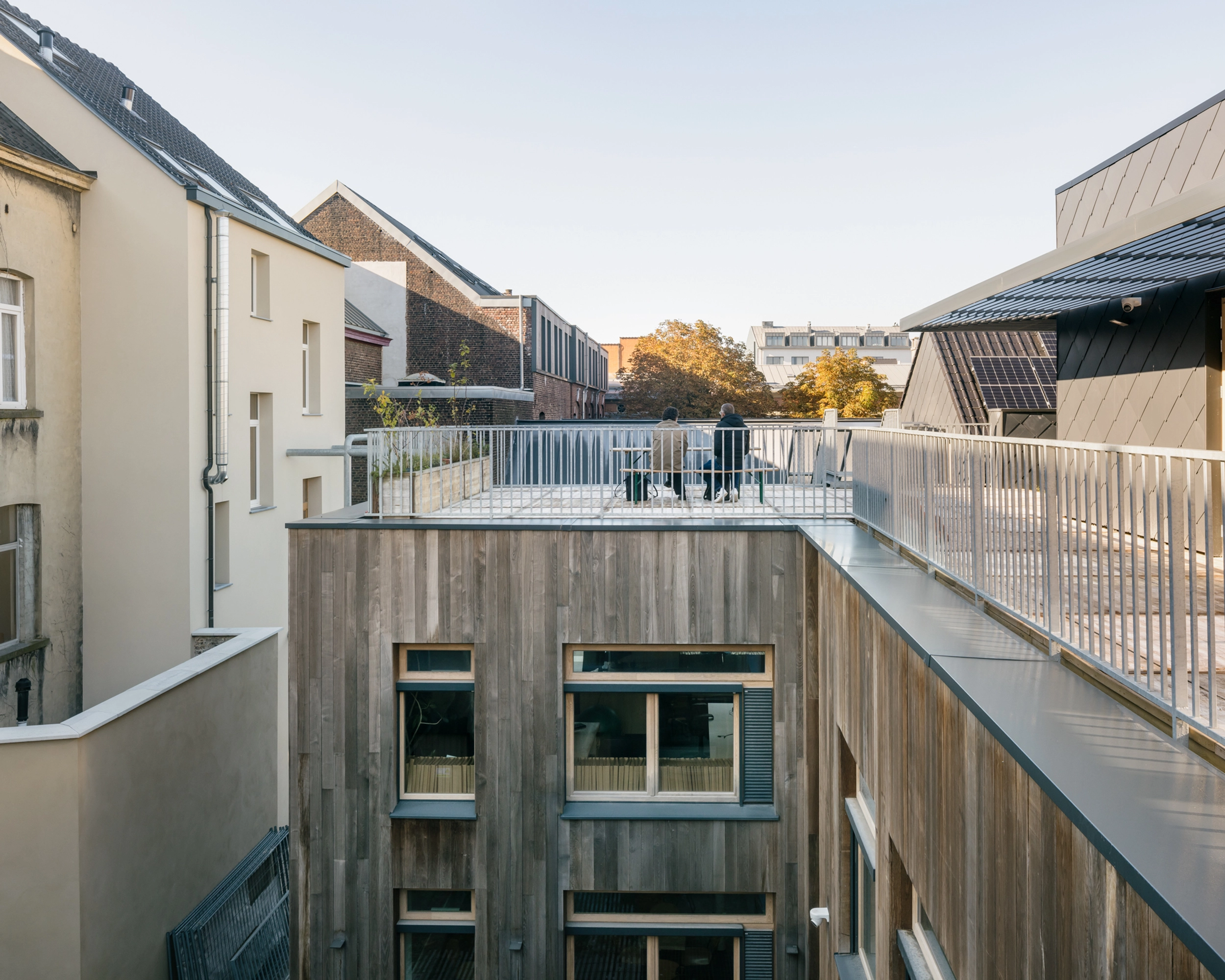
From organ workshop to Greenpeace Belgium headquarters
- Office
- Private
- Completed
- Location
Brussels
- Surface
2.300 m²
- Client
VIA Ex
- Partners
AAIA, Matriciel, VETO
- Description
Renovation and conversion project for the new headquarters of Greenpeace Belgium
The new Greenpeace Belgium headquarters occupies a dense urban block in Laeken, Brussels. The existing buildings once formed part of the organ workshop Manufacture d’Orgues de Bruxelles. To reveal the hidden qualities of this industrial ensemble and weave them into the design process, we adopted a ‘matchmaking’ method that offers a fresh view on the project’s programme. We first analyse the existing structures and the various interior and exterior climates, then ‘match’ them with Greenpeace’s specific activities – from meetings to wall climbing. The result is a right-tech, high-quality working environment, where carefully considered technology is balanced with spatial quality and sustainability.
Greenpeace won the Smart Building Award at the Green Solutions Awards Belgium 2025. The project also won bronze in the Climate Future Project Award 2024 at the Belgian Construction Awards.
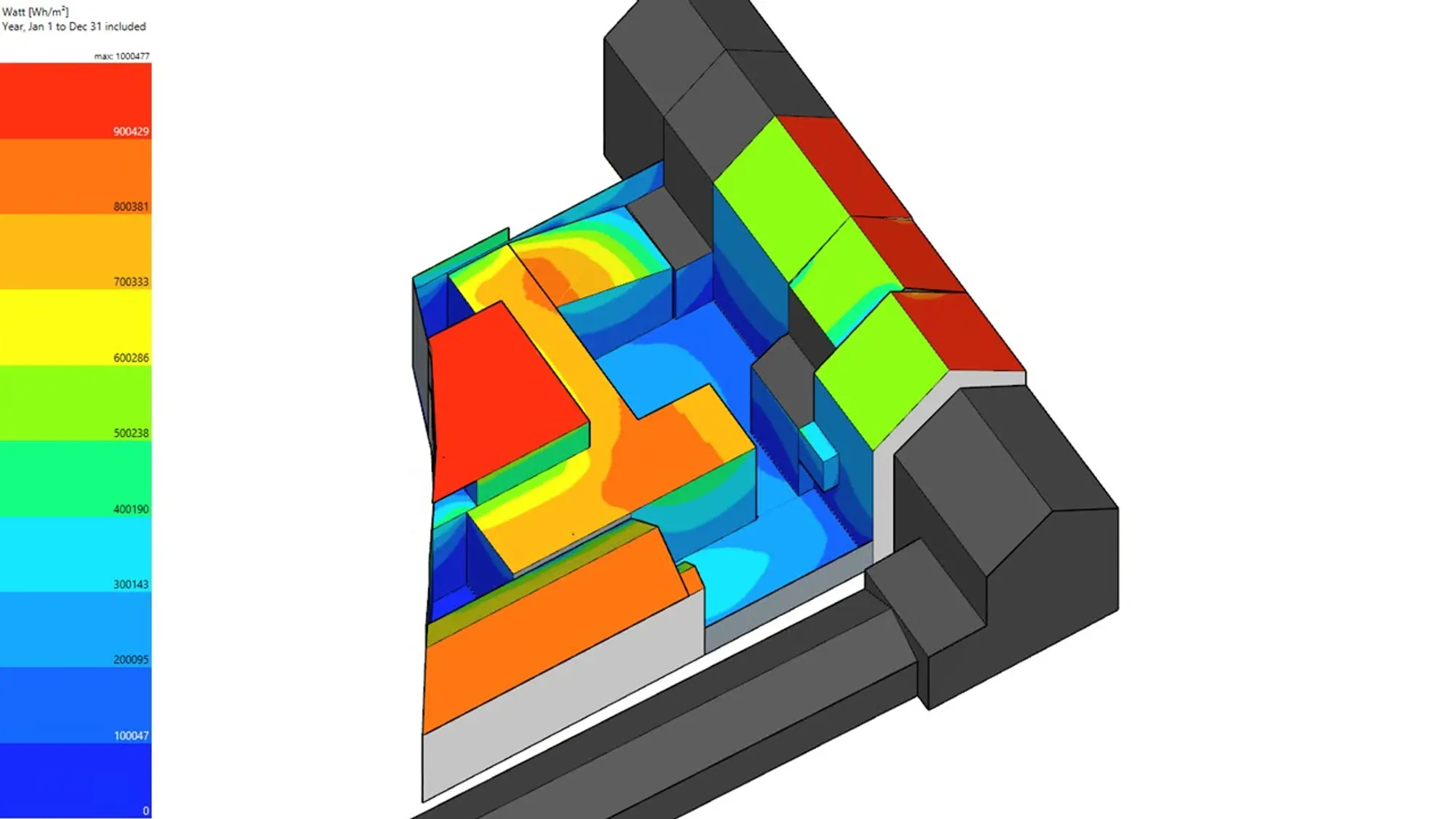
Site plan
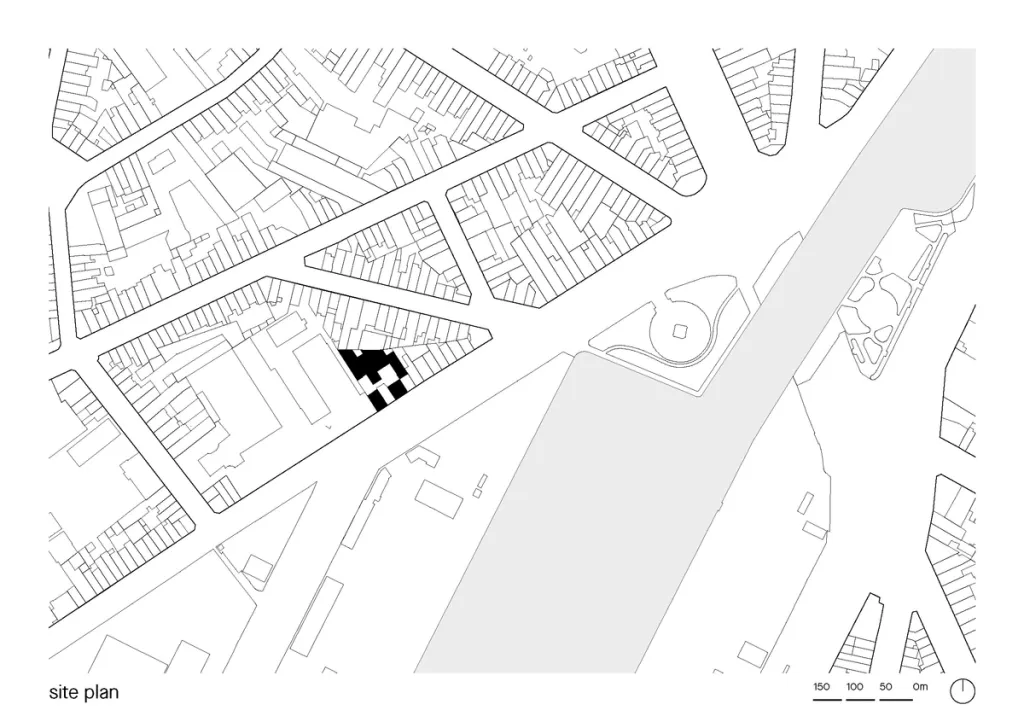
Caring for the existing
The design starts from a meticulous reading of the context. The hyper-diverse neighbourhood around the Vergote dock brings together Brussels terraced houses, wide views over the water and the industrial presence of cement silos. We extend this layered character into the project through a precise approach to existing spaces and structures. In line with Greenpeace’s philosophy, we use ‘just enough’ space, material and energy – a principle we describe as sufficiency. An adaptive comfort model allows temperature, light and ventilation to follow the outdoor climate and occupancy levels, further reducing energy consumption without sacrificing user comfort.
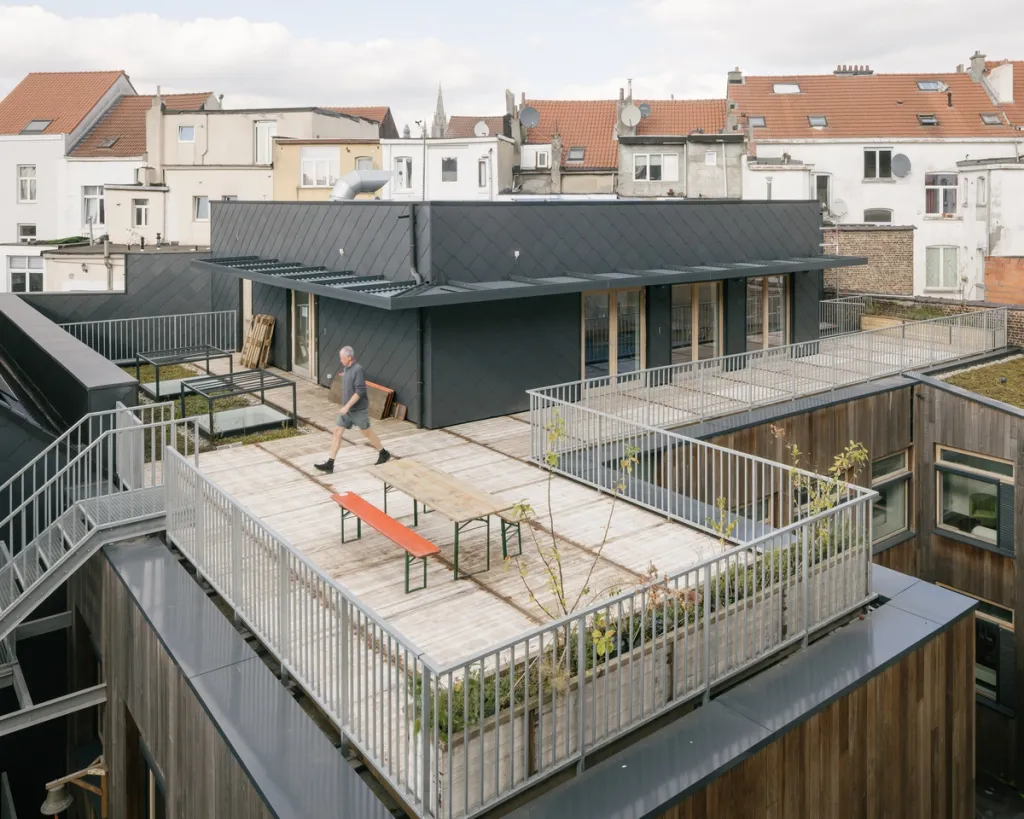
Roof terrace and extension on top of the former organ workshop. Copyright Stijn Bollaert.
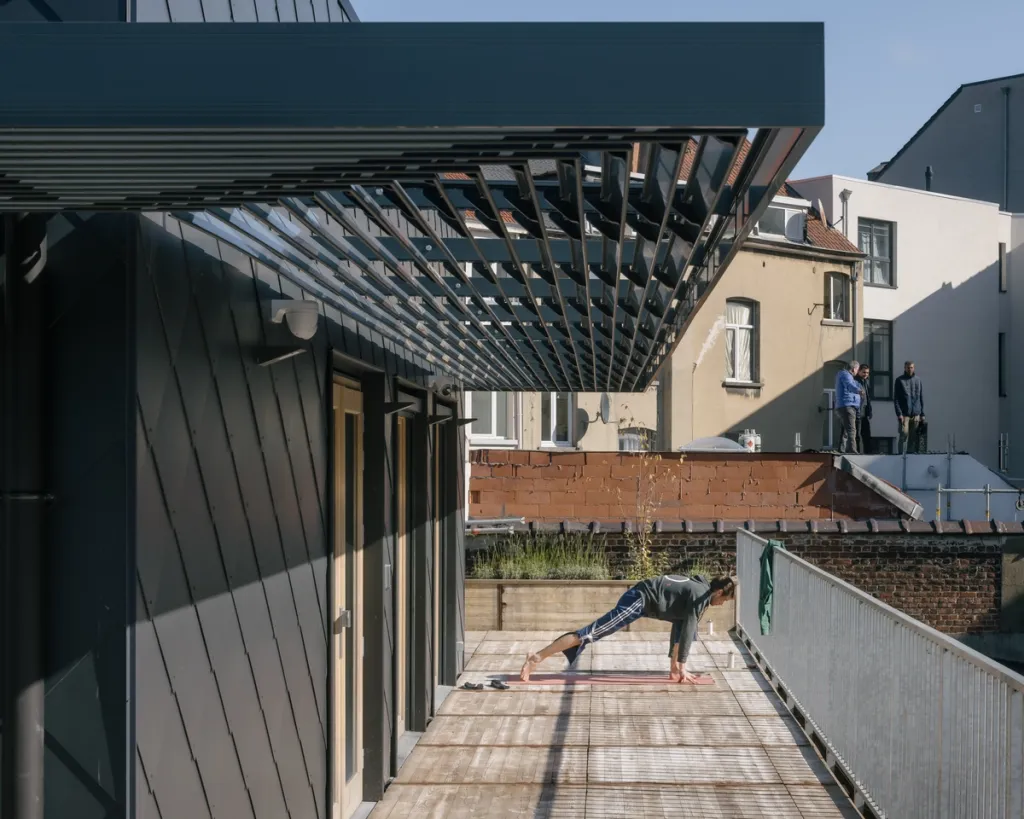
Activity-based
An intensive co-creation process allowed us to get to know Greenpeace’s day-to-day operations in depth. We organised immersion days in the former offices and an interactive session for volunteers on board the Rainbow Warrior ship in Ostend. We mapped out user profiles, needs and working patterns. One clear outcome was the explicit wish for more informal interaction and a dynamic working atmosphere.
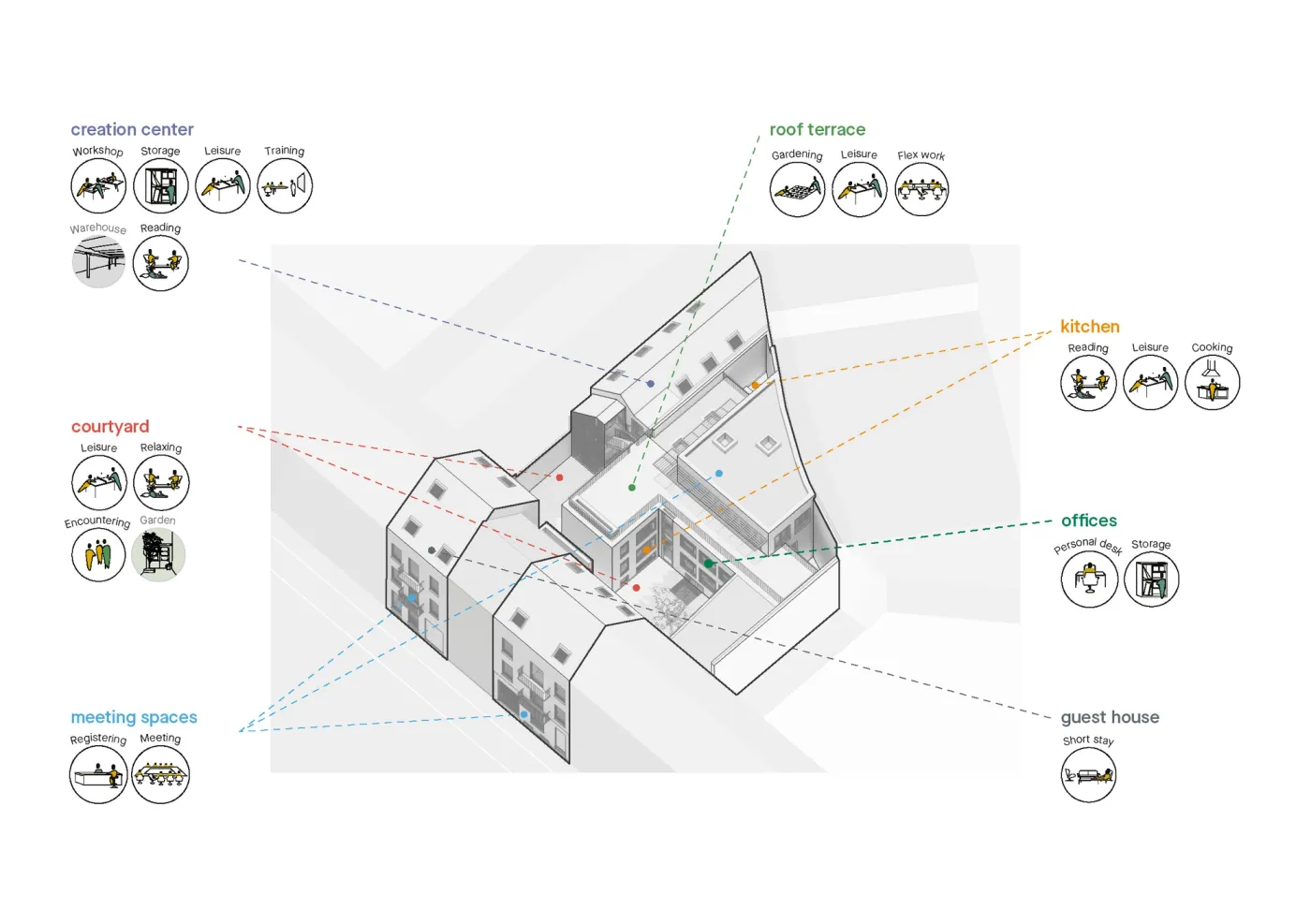
Taking an activity-based approach, we distinguish between a variety of activities: formal and informal meetings, focused work, phone calls, eating, making and climbing. The spaces are tailored accordingly, accessible to all user profiles and interconnected around a central courtyard. By sharing certain zones with local organisations, the project strengthens social interaction and a sense of community. A thoughtful clustering of functions, shared facilities and targeted acoustic separations makes it possible for multiple activities to take place simultaneously, without compromising calm or concentration.
“Fully in line with Greenpeace’s philosophy, we apply a range of strategies to use just enough space and energy. We refer to this concept as ‘sufficiency’.” Luutzen Schaap, project architect
Matchmaking between existing spaces and desired activities.
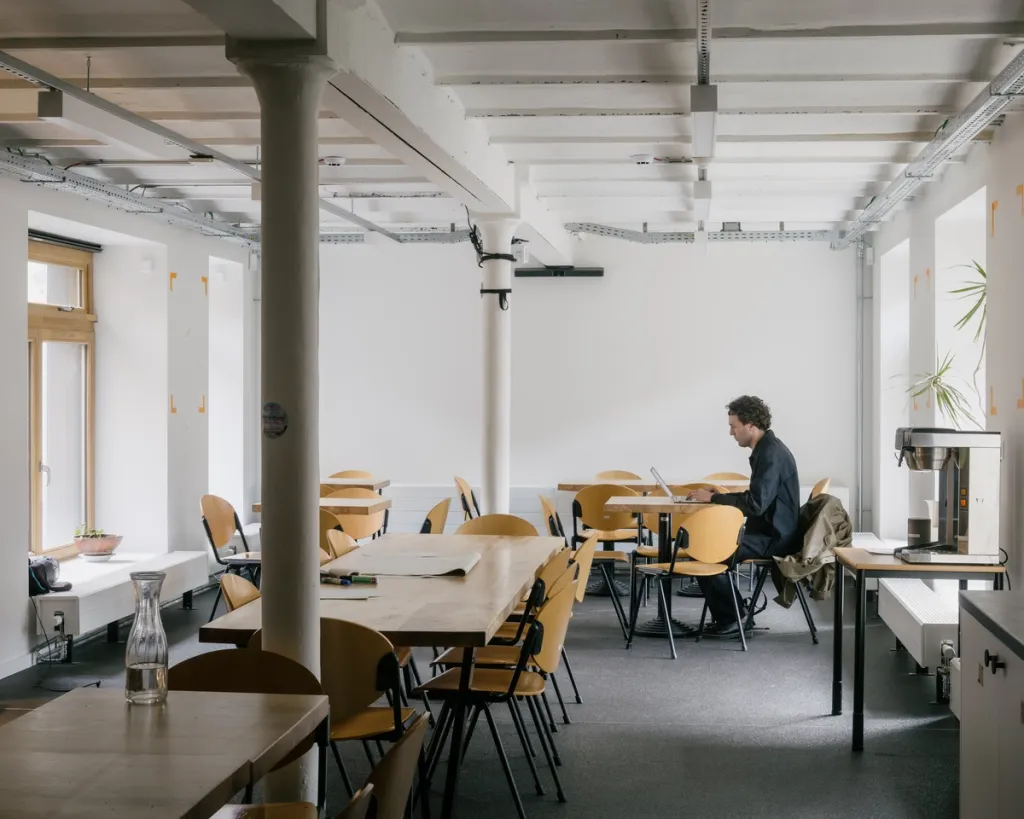
Dining hall. Copyright Stijn Bollaert.
Matchmaking
A low environmental impact here goes hand in hand with a strong architectural expression. Conservation, renovation and transformation not only reduce embodied carbon; they also unlock the full potential of the existing spatial layers. The sufficiency philosophy translates into seemingly obvious decisions: the former organ workshop becomes a makerspace for activists, while the terraced houses along the street are converted into guest rooms.
A carefully composed sequence of indoor and outdoor spaces, public and private zones, and more or less conditioned climates offers the Greenpeace team multiple ways to organise itself. Air plays a crucial yet invisible role. Ventilation is controlled room by room, enabling diverse use, limiting the number of shafts and avoiding heavy structural interventions. The system is coupled to natural ventilative cooling: windows open and close automatically in response to temperature, wind and CO₂ levels. With minimal technology, the existing building’s potential is refined for its next life cycle.
This matchmaking approach and sufficiency-driven philosophy together produce a distinctive, sustainable headquarters for Greenpeace Belgium, in which the former organ workshop gains a new contemporary resonance.
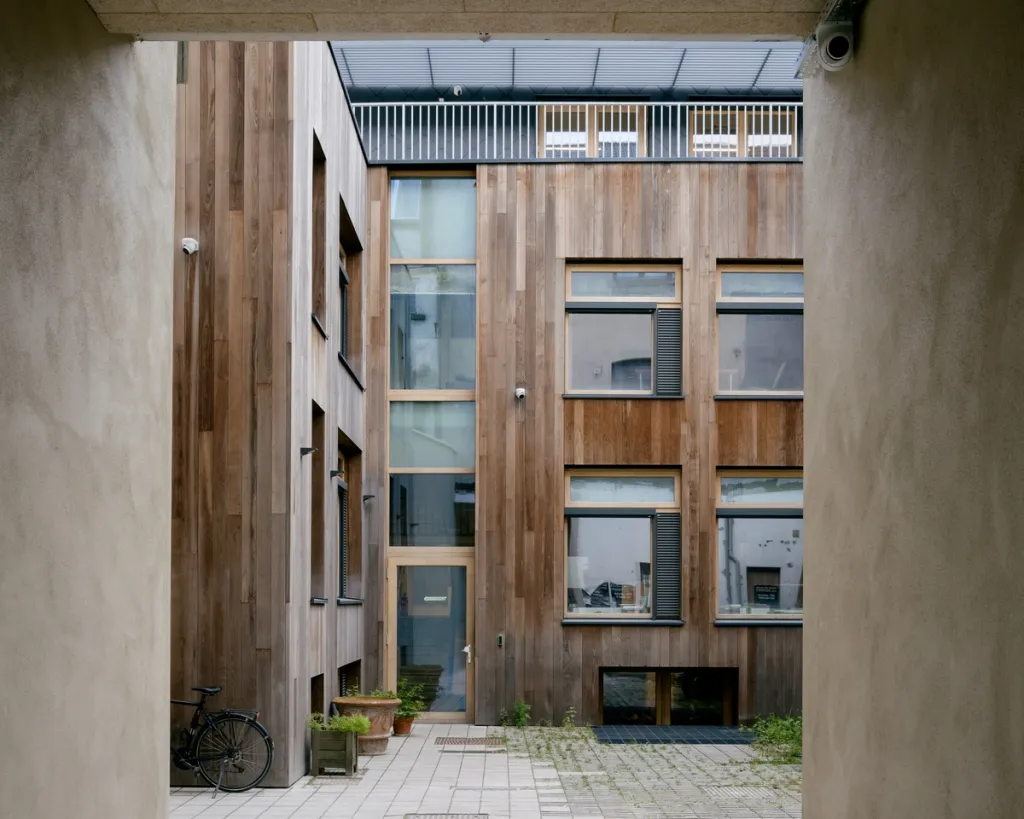
Covered passageway leading to the central courtyard. Copyright Stijn Bollaert.
Roof terrace and extension on top of the former organ workshop. Copyright Stijn Bollaert.
Related projects & research
- Education
GBS Leefdaal
- Care
Centre Régional Psychiatrique Les Marronniers
- Infrastructure
- Industry
Reynaers Aluminium
- Retail
McDonald’s Mechelen
- Masterplan
- Mixed-use
Gelatine quarter
- Care
Care Home Booghuys
- Hospital
Joseph Bracops Hospital
- Education
CUZG – Centre Universitaire Zénobe Gramme
- Mixed-use
- Infrastructure
Mobility Hub
- Care
Broydenborg

- Residential
- Mixed-use
Vanden Tymple - Diestestraat
- Office
- Public