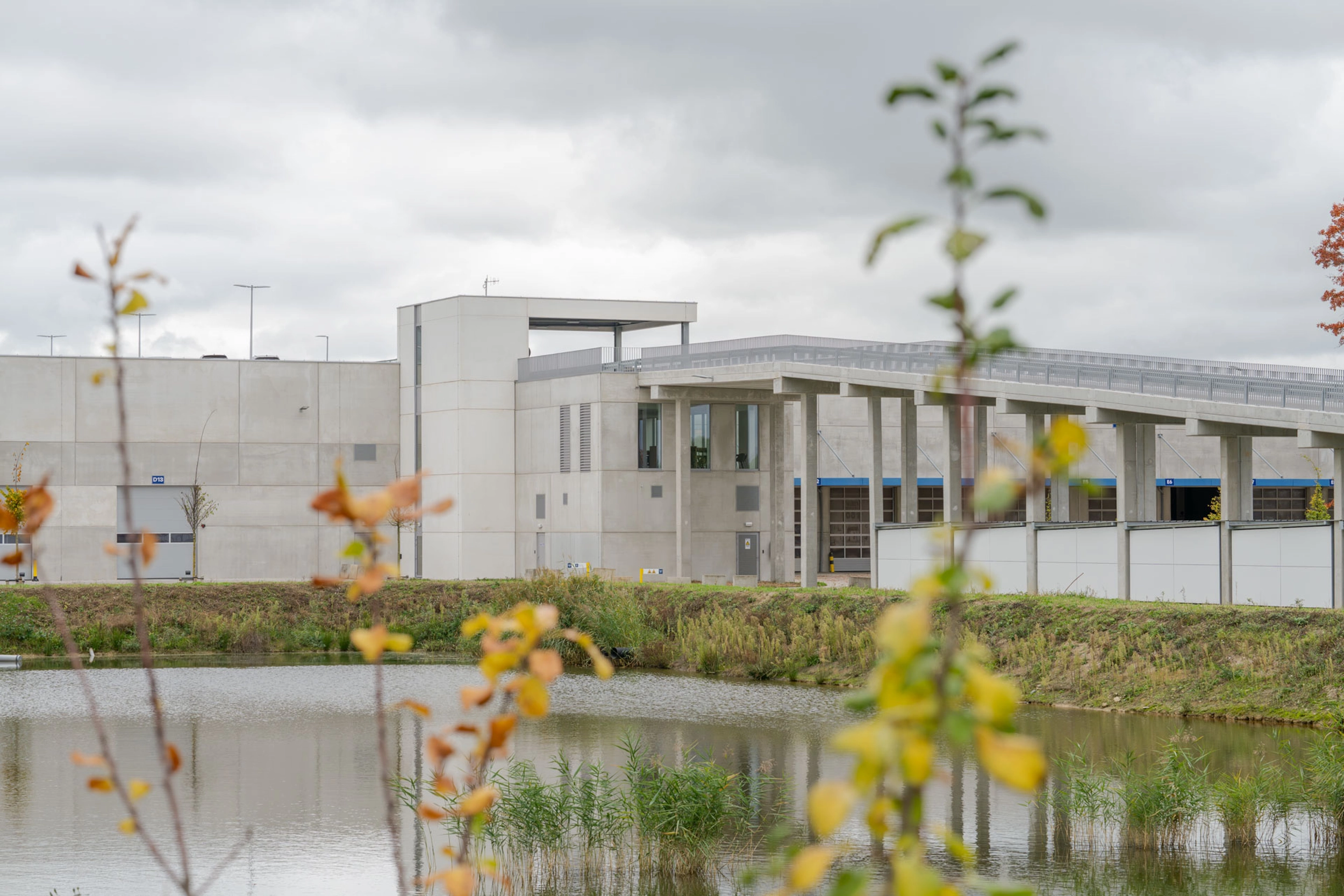
Building high, landing softly: a hyper-compact warehouse in a green setting
- Infrastructure
- Industry
- Private
- Completed
- Location
Duffel
- Surface
9.134 m² of buildings + 17.190 m² of infrastructure + 10.700 m² of green space
- Partners
M-gineers
- Client
Reynaers Aluminium
- Description
Warehouse with rooftop car park, social areas and green zone for Reynaers Aluminium. Includes an automated high-bay warehouse with a height of 25 metres.
A large capacity with a modest footprint
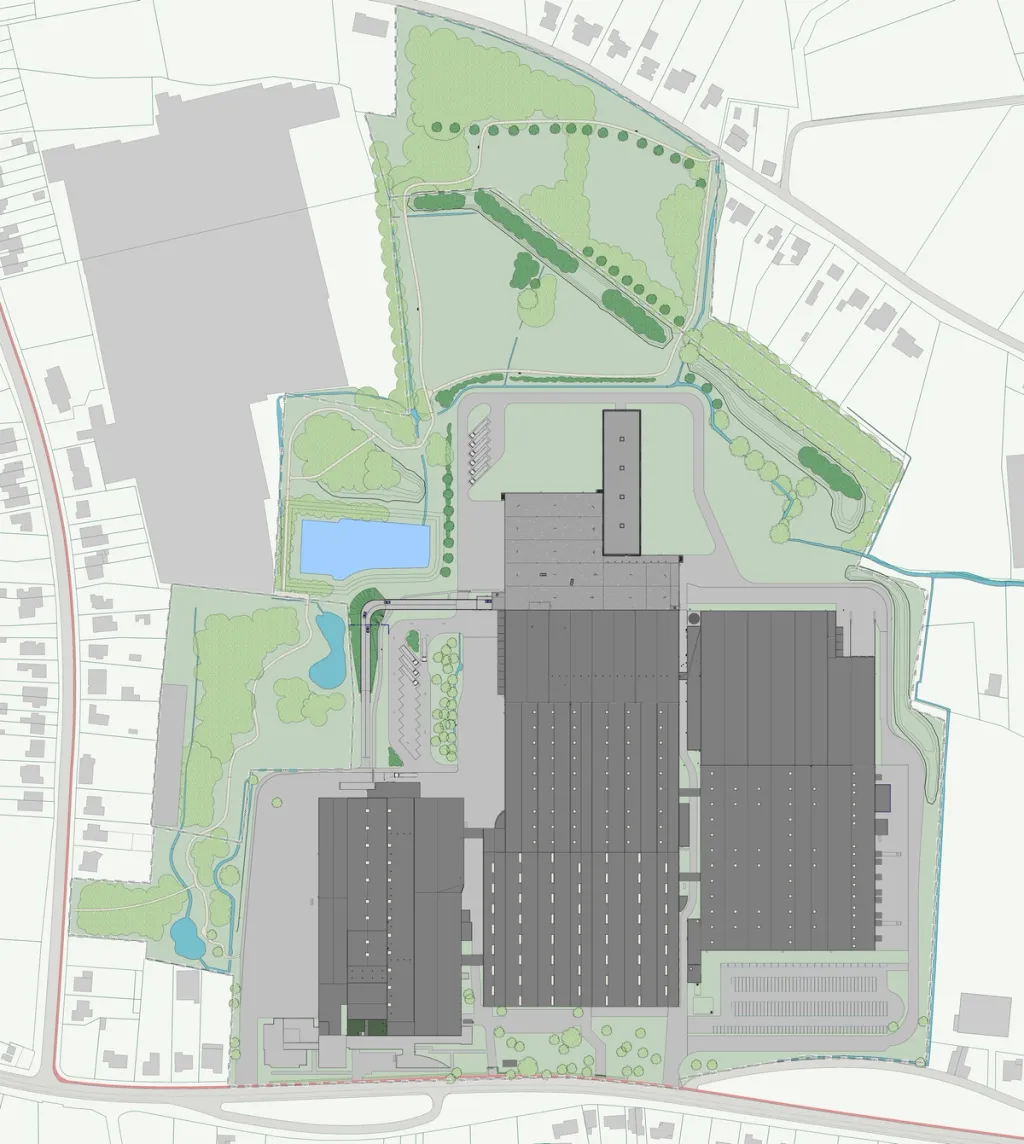
When Reynaers Aluminium decided in 2019 to significantly expand its warehouse capacity, the classic solution seemed obvious: more floor area, more storage, more parking spaces. However, the site is surrounded by valuable nature and is characterised by a high groundwater level. That’s why, together with the client, a radically more compact alternative was devised: a hyper-compact high-bay warehouse with an integrated transfer zone and rooftop car park, reconciling logistical efficiency with landscape quality.
Site plan
“The increasing pressure on space forces us to approach logistics environments differently. We can no longer think only in square metres, but in cubic metres: building more compactly and smartly stacking functions. In this way, we reclaim open space and create efficient business processes.” Lennart Luchtens, architect
Fully automated high-bay warehouse
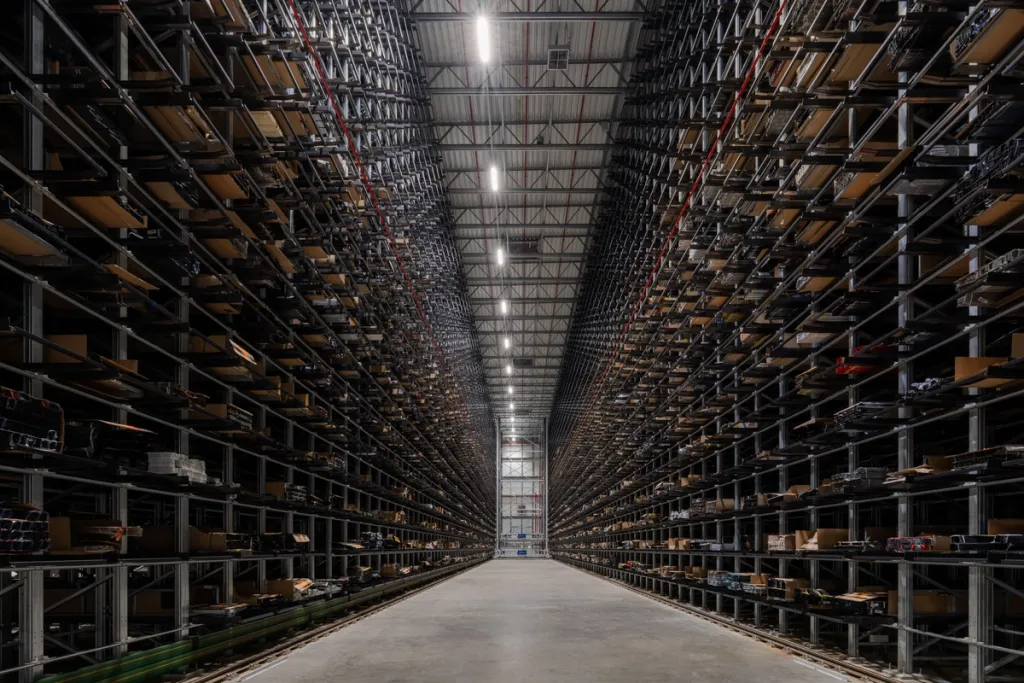
A vertical logistics machine as an architectural gesture
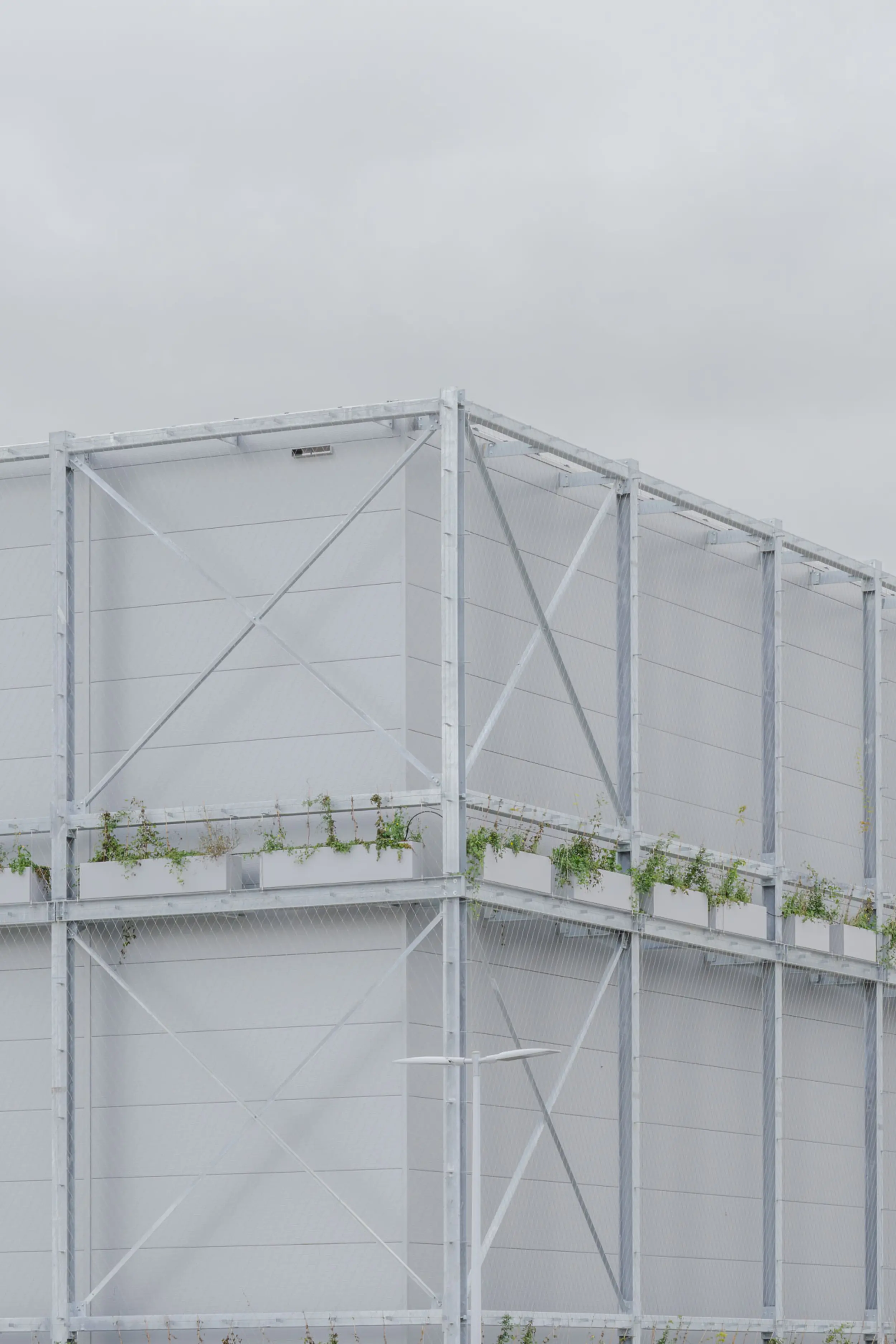
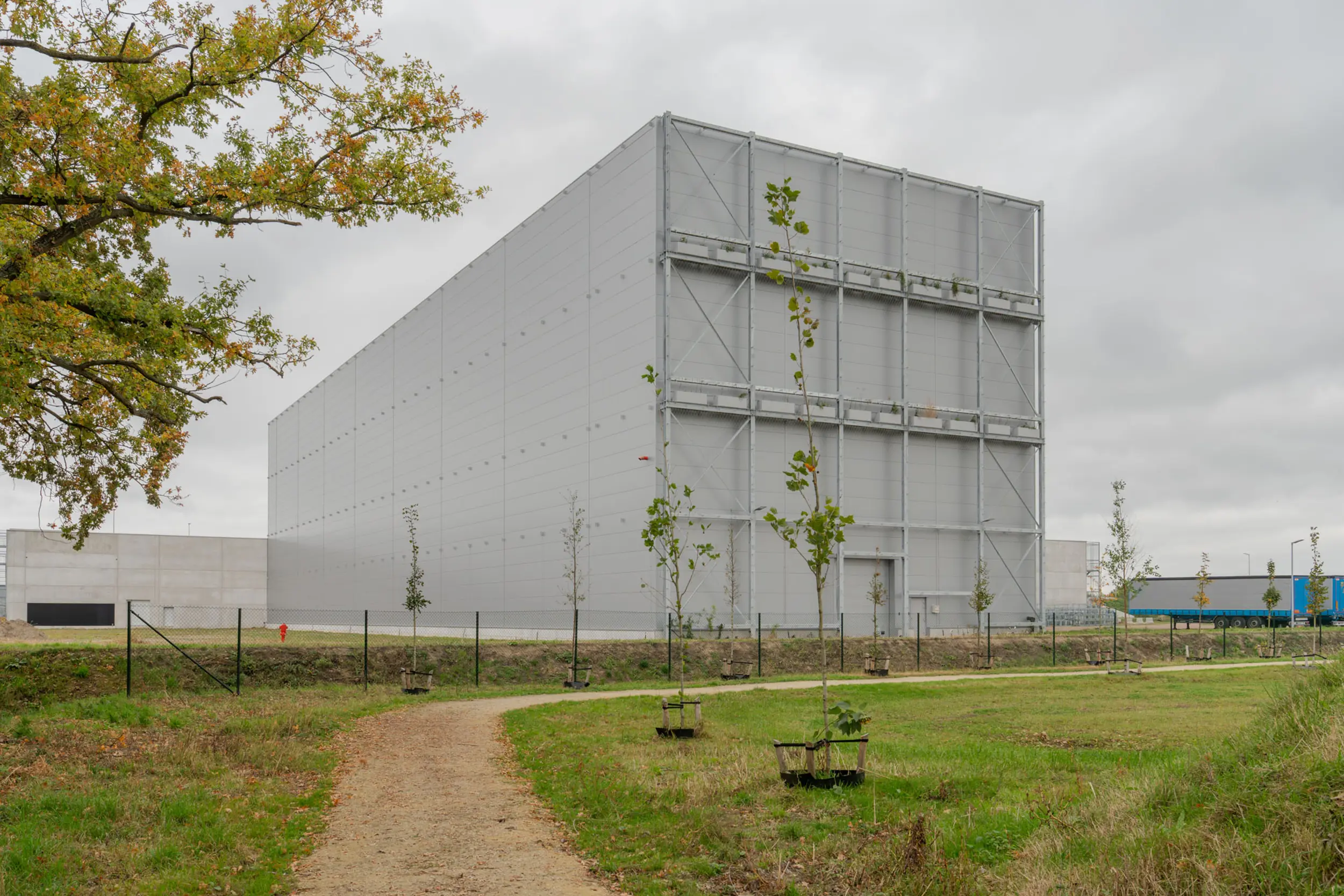
The high-bay warehouse forms the heart of the extension: a dense, optimised storage machine that replaces the classic horizontal layout with a vertical approach. By building upwards, the impact on ground level is drastically reduced. Thanks to fully automated technology, profiles are loaded and unloaded in a single movement, while up to three times more profiles can be stored per square metre than in a warehouse with conventional racking. The new transfer zone links seamlessly with the existing logistics flows and enables fast, efficient circulation. The volume presents itself as a clear, functional skeleton that reflects the industrial logic. Climbing structures and integrated planters soften the appearance and gradually blur the boundary between building and surroundings.
Rooftop parking as dual use of infrastructure
The upscaling required not only additional storage, but also more social functions and significantly more parking spaces for employees. Parking at ground level, however, would have introduced large paved surfaces and put pressure on the site’s ecological capacity, while building underground proved unfeasible due to the high groundwater table. The solution came in the form of multiple land use: a rooftop car park on top of the transfer zone. A carefully integrated bridge and ramp naturally guide car traffic towards the building.
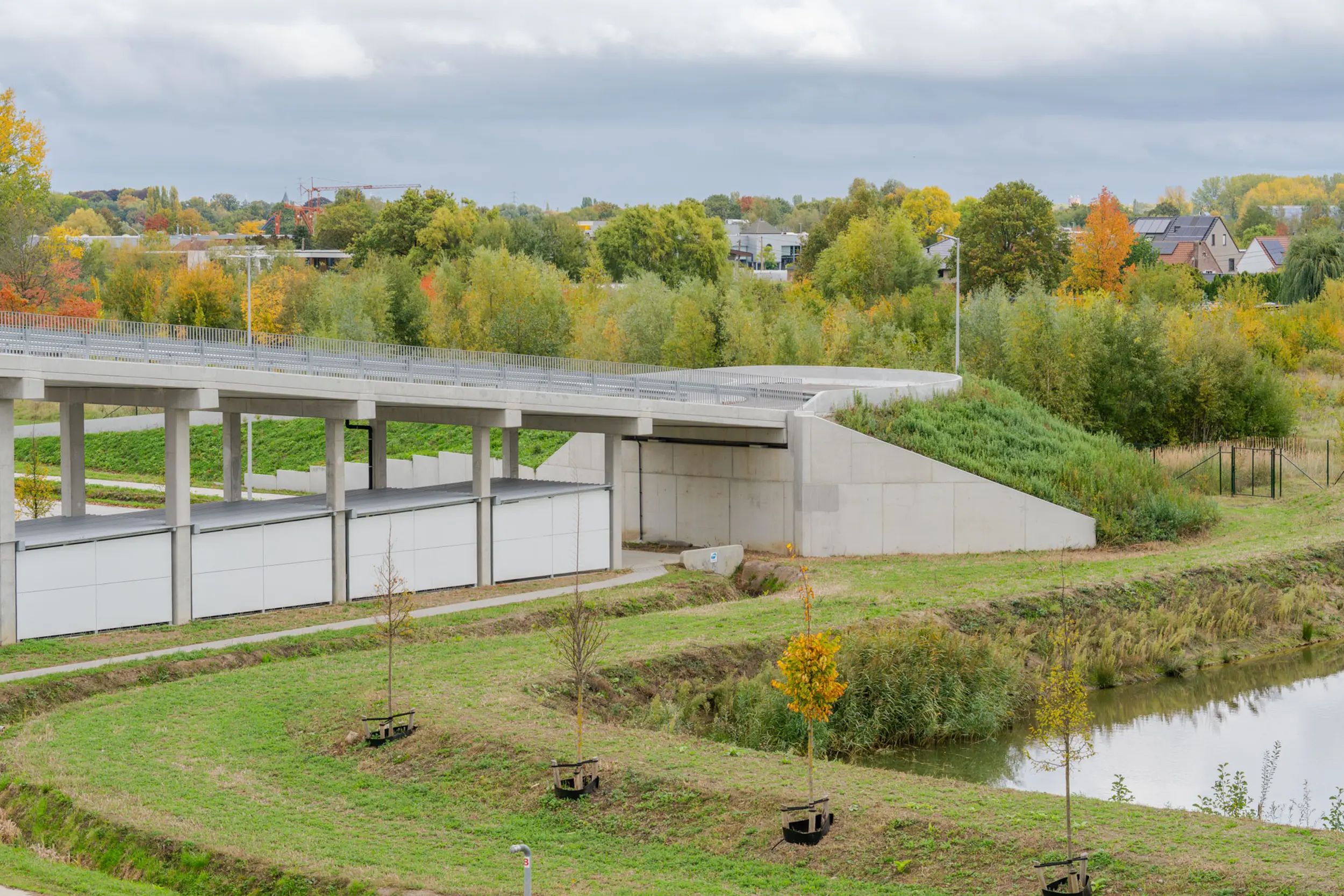
Intersection of flows and social anchor point
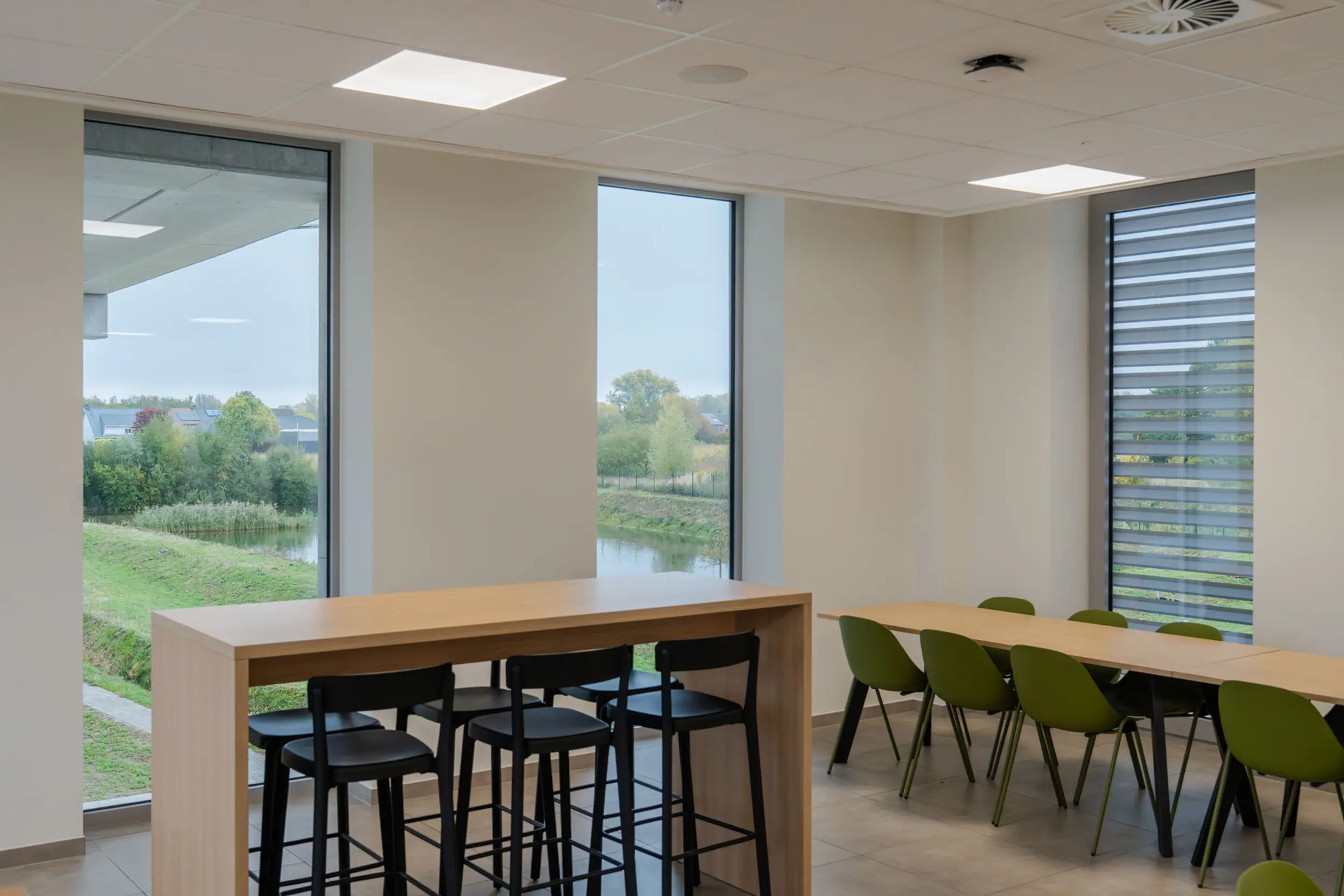
All traffic flows – freight traffic, cars and pedestrians – converge at the corner of the extension. At this point, changing rooms, sanitary facilities and a canteen are provided, offering generous views over the surroundings. The result is a user landscape that is both functionally efficient and pleasant, in which arriving, working and taking breaks follow one another logically. Combining parking and working not only delivers economic benefits – less infrastructure, less hard surfacing – but also a high-quality daily experience for employees, who spend their breaks looking out onto greenery instead of an expanse of asphalt.
From expansion to ecological added value
With this intervention, Reynaers Aluminium now has a future-proof warehouse volume and parking capacity without sacrificing green space. Behind the building, part of the natural area has been redesigned with a fine-grained system of ditches for rainwater infiltration, making the landscape more resilient to both drought and heavy showers. A new footpath opens up the area to local residents, allowing them to enjoy the increased biodiversity.
Related projects & research
- Education
GBS Leefdaal
- Care
Centre Régional Psychiatrique Les Marronniers
- Retail
McDonald’s Mechelen
- Masterplan
- Mixed-use
Gelatine quarter
- Care
Care Home Booghuys
- Office
Greenpeace Belgium HQ
- Hospital
Joseph Bracops Hospital
- Education
CUZG – Centre Universitaire Zénobe Gramme
- Mixed-use
- Infrastructure
Mobility Hub
- Care
Broydenborg

- Residential
- Mixed-use
Vanden Tymple - Diestestraat
- Office
- Public