Right-tech: fewer systems, greater climate gains
Right-tech strategies demonstrate how fewer technical systems and climate-responsive design reduce both operational and embodied impact.
 Joost Declercq
- Sufficiency
Right-tech explores how fewer building services can lead to greater climate gains. Not only operational environmental impact, but also the embodied impact of materials and installations is becoming critical, especially since building services can account for 14–45% of the embodied impact of office buildings. Right-tech strategies reduce material use and avoid refrigerants. Right-tech already starts in the concept phase, with climate-responsive design choices such as thermal mass, daylight and natural ventilation. Projects in Leuven, Brussels and Meise demonstrate how a robust basic concept, hybrid or natural ventilation and correctly sized HVAC systems together reduce both operational and embodied environmental impact.
Right-tech: fewer systems, greater climate gains
In buildings, more and more space is being provided for technical installations to ensure an optimal indoor climate. But is that really necessary? Fewer building services often lead to a lower environmental impact if the right strategies are applied: right-tech offers methods to determine the right amount of building services.
Operational and embodied environmental impact
The environmental impact of buildings is divided into operational and embodied impact. Operational environmental impact is the impact during use, mainly the energy consumption of systems that stabilise the indoor climate. For a long time, the focus was on reducing this impact. Attention is now shifting towards the construction process: the environmental impact of production, assembly and maintenance, i.e. the embodied environmental impact.
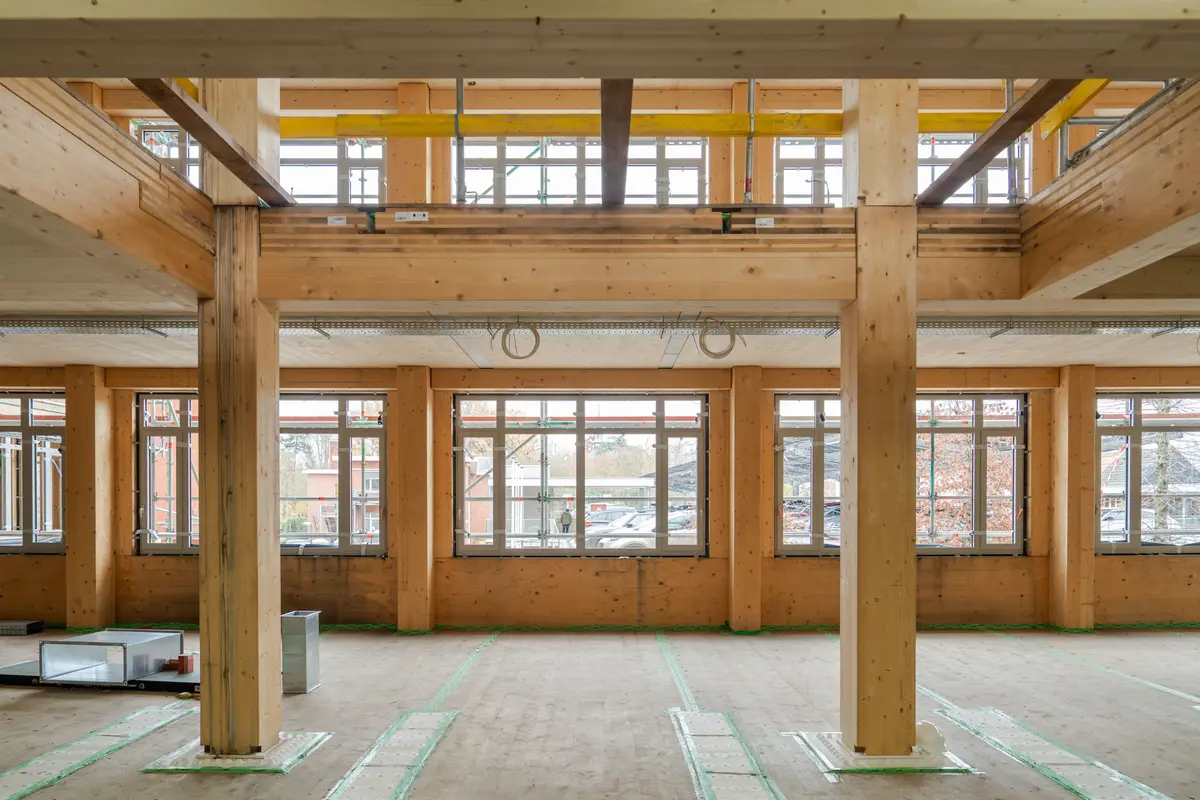
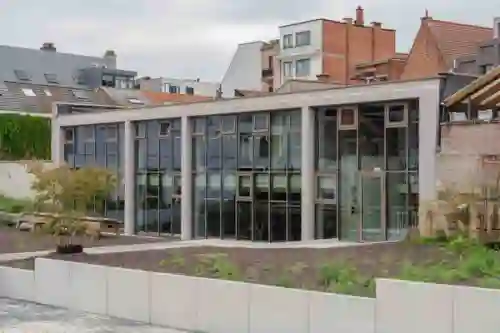
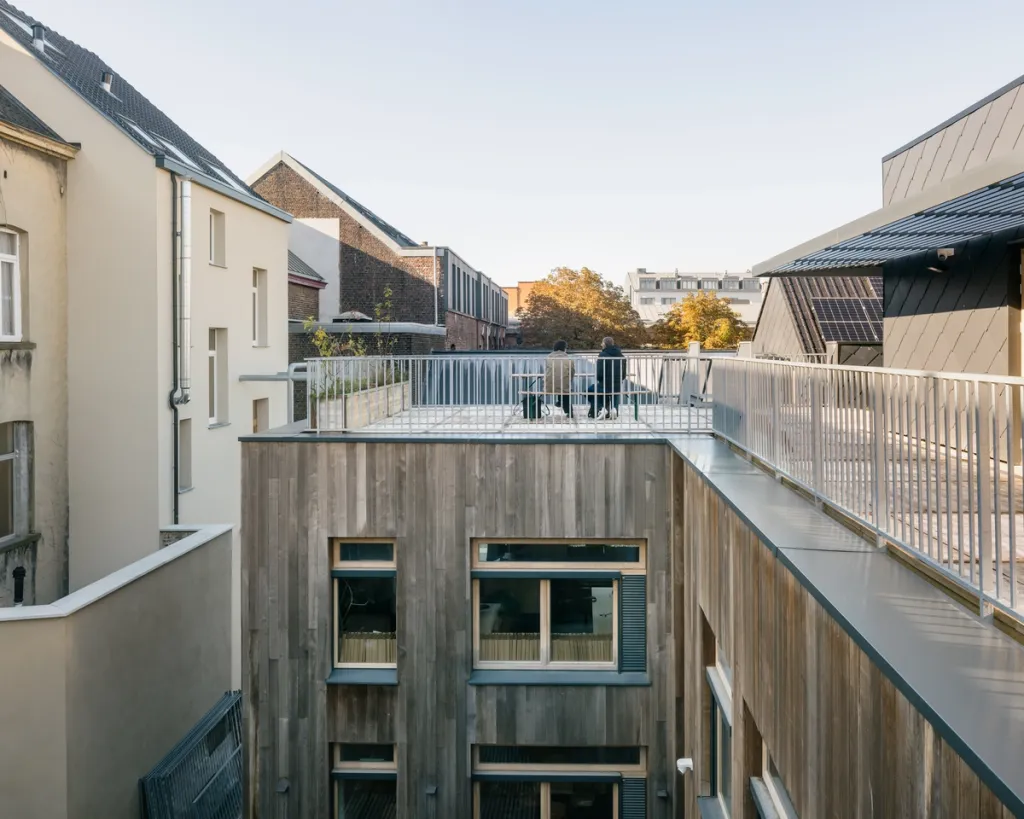
Archipelago’s office in Leuven, designed according to Right-tech principles. Copyright Elias Derboven.

Payback time for the environment
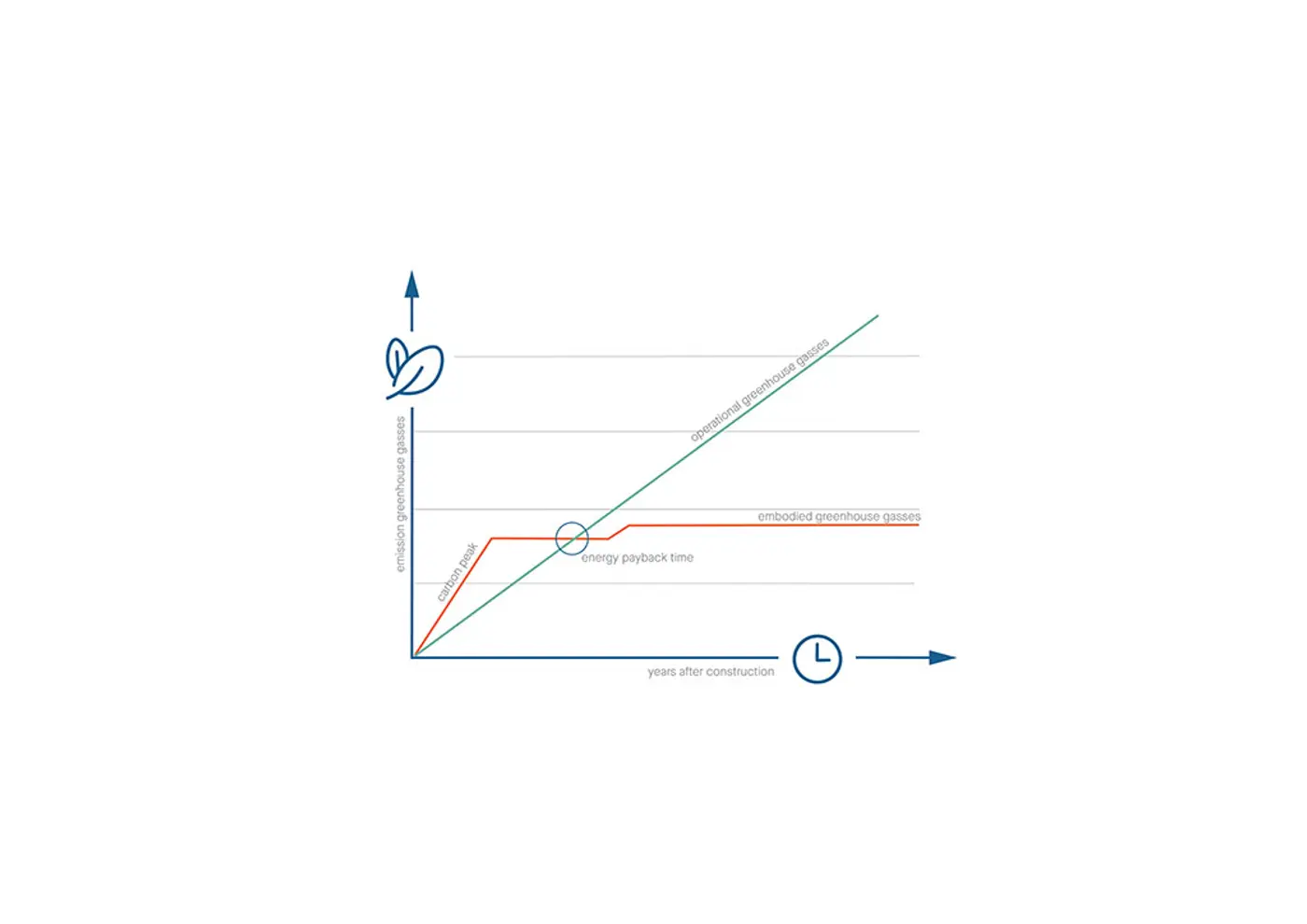
As a result of efforts to reduce operational environmental impact, embodied impact has increased. In many buildings, it is now higher than the operational impact, with a considerable “carbon peak” even before the building is in use. Any increase in embodied impact must therefore be compensated by a lower operational impact, but this “payback time for the environment” can be long (Rock et al., 2020). Optimising both current operational and embodied environmental impact must therefore be central.
Simplified version of the “Martin Röck et al. (2020) – greenhouse gas reduction” graph. This graph shows embodied impact in relation to operational impact over the period following the construction of the building. It illustrates that the higher the embodied impact (and the initial carbon spike), the longer the environmental payback time.
The embodied environmental impact of technical installations
Recently, the embodied environmental impact of construction products, calculated using the TOTEM tool, has become an important decision factor. The embodied impact of technical installations was long underestimated due to their complexity and a lack of material data. Recent studies, however, show that 14% to 45% of the embodied environmental impact of office buildings is caused by building services (Ramon, 2021). Installations often contain (rare) metals and refrigerants with a high Global Warming Potential. Key hot spots are HVAC distribution and emission systems, electrical cabling, refrigerants and PV panels.
Right-tech as a strategy
Right-tech strategies reduce embodied environmental impact by using fewer materials and avoiding high-GWP refrigerants. Different technical components have different life spans and impacts; this must be taken into account (Declerqc, 2020). The quantity and impact of building services are already determined in the concept phase. Climate-responsive design strategies – thermal mass, high-quality daylight and natural ventilation – enable a comfortable indoor climate and significantly reduce net energy demand. Research shows that these strategies are particularly important under both current and future climate conditions (Ramon, 2021; Declerqc, 2021).
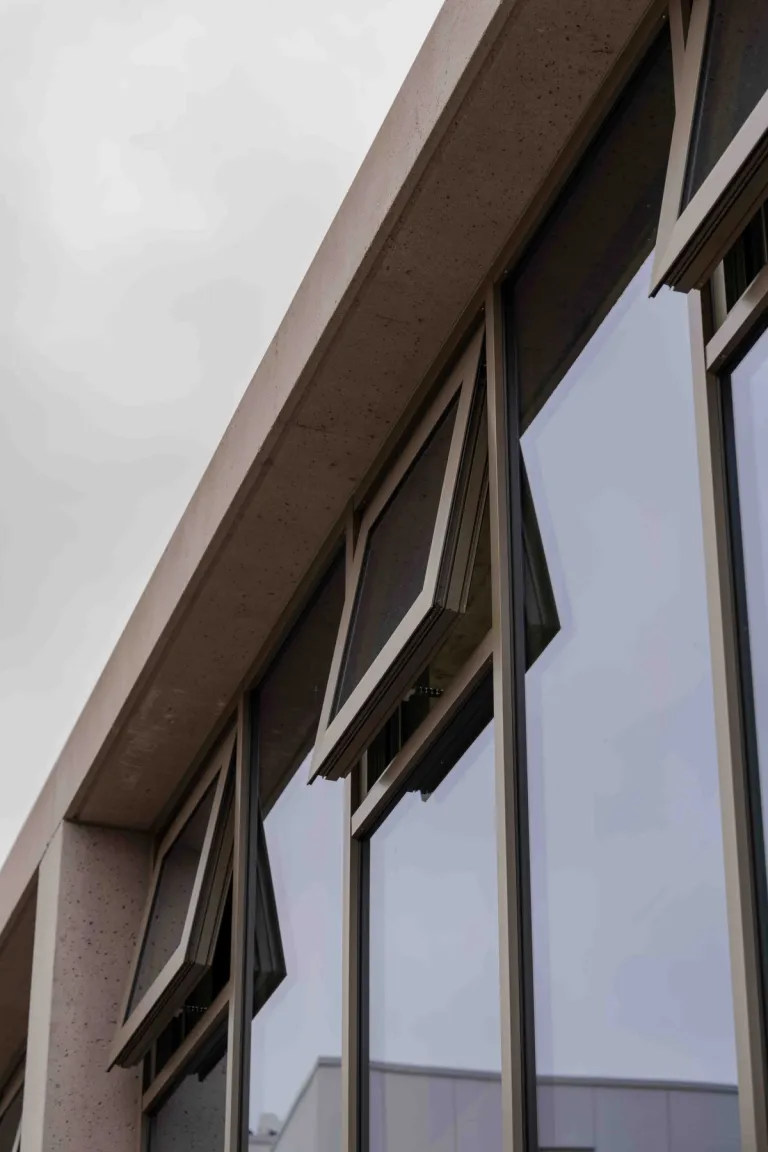
Archipelago’s office in Leuven, with automatically opening windows based on continuous measurements of temperature, humidity and ventilation flow rates. Copyright Elias Derboven.
Archipelago office, Leuven: advanced simulations
In the Archipelago office in Leuven, orientation, façade glazing and thermal mass were carefully tuned to the natural ventilation concept. Simulations, based on standards but using realistic values, enabled further reductions. Together with KU Leuven, the building was also evaluated under future climate scenarios. These show that good summer comfort is achievable without mechanical cooling. Only under extreme conditions is additional cooling via a heat pump and chilled ceilings required. All installations are visible and easily accessible to optimise maintenance and service life.
Greenpeace headquarters, Brussels: hybrid ventilation concept
In the new Greenpeace headquarters, building services were greatly minimised thanks to a hybrid ventilation system combining demand-controlled natural ventilation via openable windows, mechanical extract and heat recovery. This keeps the number and length of ventilation ducts limited and reduces material impact. Here too, thermal mass, solar shading and natural day- and night-time ventilation are applied intelligently, supported by careful sizing, to further reduce environmental impact.
Greenpeace headquarters in Brussels. Copyright Stijn Bollaert.
Pachthof, Botanic Garden, Meise: optimising summer and winter comfort
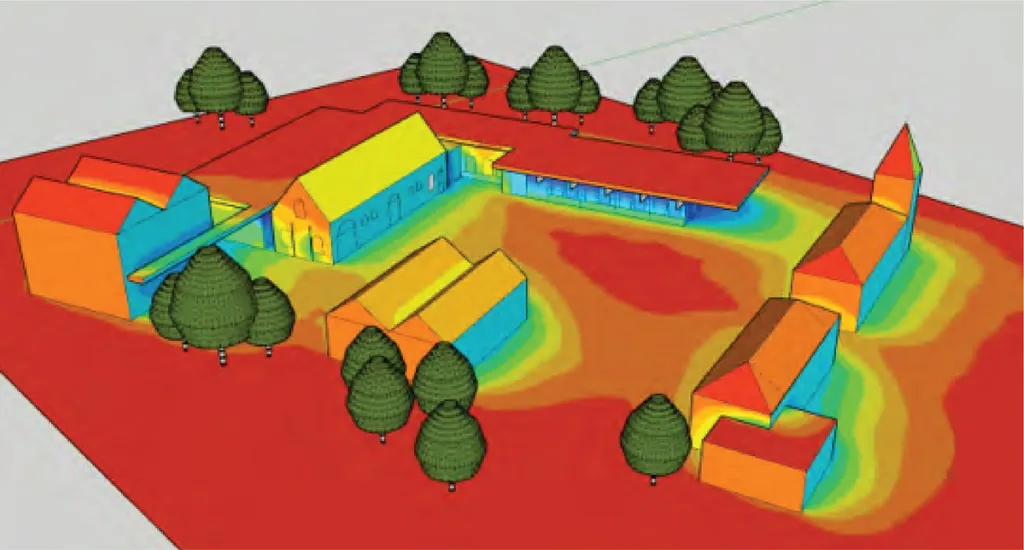
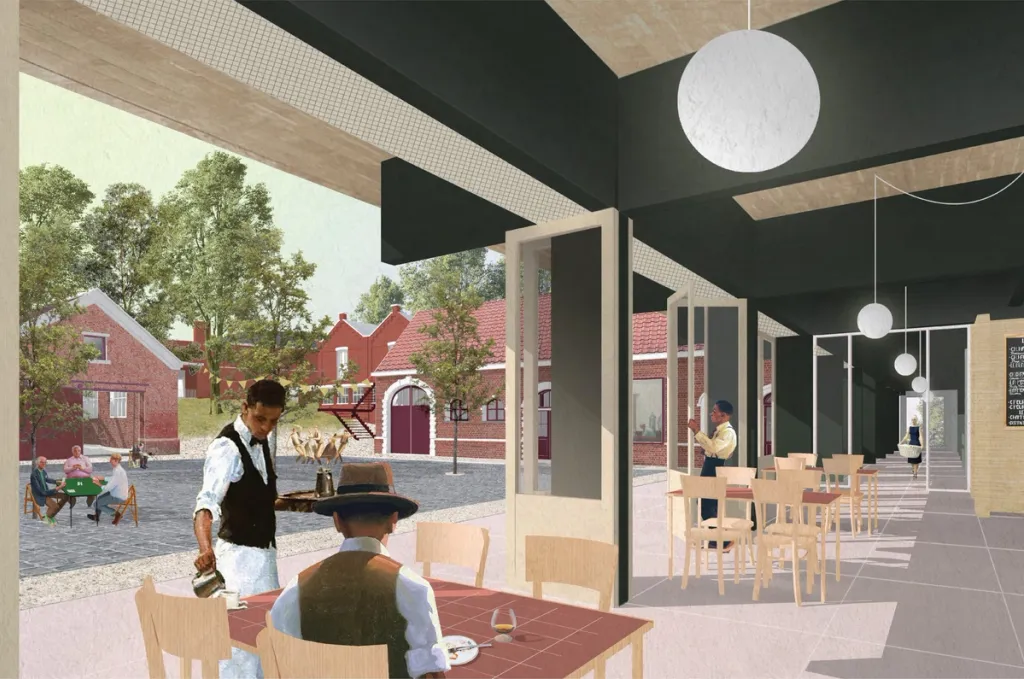
At the Pachthof restaurant, solar gains are maximised in winter and solar loads are limited in summer. With natural cooling via automatically controlled windows, summer comfort is ensured without active cooling and energy demand is reduced.
Pachthof Meise, sunlight study
Robust base concept and smart building services
Reducing embodied impact through right-tech strategies starts with a robust basic concept: a form, orientation and structure that retain heat. Add to this natural or hybrid ventilation, correctly sized HVAC systems and flexibly integrated, long-lasting technologies. In this way, both the operational and the embodied environmental impact of buildings are optimised.
Pachthof Meise, interior view
References
Martin Röck, et al. (2020). Embodied GHG emissions of buildings – The hidden challenge for effective climate change mitigation, in: Applied Energy (https://www.researchgate.net/publication/337591460_Embodied_GHG_emissions_of_buildings_-The_hidden_challenge_for_effective_climate_change_mitigation)
Delphine Ramon, (2021). Towards future-proof buildings in Belgium – Climate and life cycle modelling for low-impact climate robust office buildings, Phd Thesis, KU Leuven (https://www.researchportal.be/en/publication/towards-future-proof-buildings-belgium-climate-and-life-cycle-modelling-low-impact)
Joost Declercq, (2020). Circulaire economie toegepast op technische installaties – Technische installaties, aanpasbaarheid en reversibiliteit, Seminarie Duurzame Gebouwen, Leefmilieu Brussel (https://leefmilieu.brussels/sites/default/files/user_files/sem05-201016-6-jd-nl.pdf and https://leefmilieu.brussels/sites/default/files/user_files/sem05-201016-6-jd-fr.pdf )
Joost Declercq, et al. (2021). The feasibility of natural ventilative cooling in an office building in a Flemish urban context and the impact of climate change, Proceedings of the 17th IBPSA Conference (https://doi.org/10.26868/25222708.2021.30811)
Related projects & research
- Residential
- Mixed-use
- Masterplan
- Residential