Design for the user: scenario-based design
Our goal as a designer includes encouraging and supporting children in their learning process, offering the elderly and vulnerable people a safe and supportive environment, allowing people to develop in their working environment, and so much more. We place people at the ‘heart’ of our architecture and strive for a (built) environment that functions as a protective cocoon, catalyst, haven, etc. for the user.
 Peter-Willem Vermeersch
 Jo Van Hees
- Wellbeing
Scenario Based Design keeps the end user at the heart of the design process by translating their routines, emotions and needs into personas and spatial scenarios. Through immersion sessions, observations and interviews, diverse user profiles are developed and used as a reference in every design phase. In projects such as HQ Greenpeace, De Kerselaar and the Montgomery police station, personas reveal hidden needs: connection, stress reduction, inclusion, safety, recovery and a sense of home. This leads to environments that combine activity and comfort, with spaces attuned to concrete actions and rhythms, where users can take responsibility and find both activation and opportunities for decompression and recovery.
Focus on users through Scenario Based Design with personas as leitmotif
As designers, it is essential that we put ourselves, throughout the design process, in the position of how end users experience their environment. This is complex. Because experiences, motivations and needs are diverse and the process itself is complex, the focus on the user can easily fade. The Scenario Based Design methodology helps to keep the end user at the centre of the process, at every stage and with every design change. We describe these end users as ‘personas’.
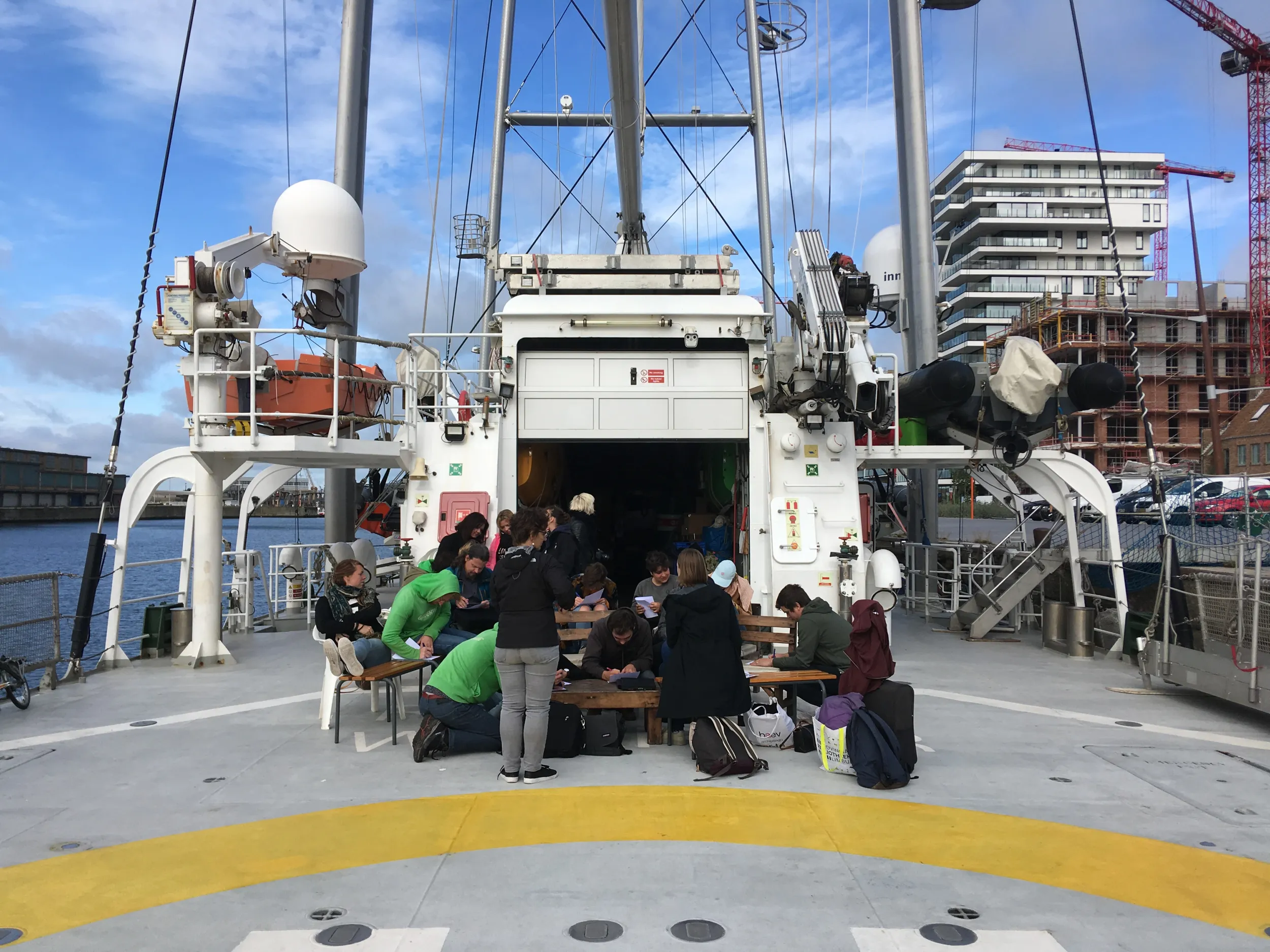
We first map out the end users. We organise immersion sessions in which the design team actively takes part, over several days, in activities with users in the existing setting, supplemented by interviews, observations and evidence-based data. In this way, we gain insight into the diversity of experience, vulnerability and motivation and develop personas that each represent a unique aspect. Through scenarios, we let these personas follow a spatial journey across the site and through the buildings, guided by actions, needs and memories. They thus become the leitmotif of the design. At every stage, we test the design with stakeholders in workshops to assess whether it becomes an optimum environment for all users.
HQ GREENPEACE: a place for connection, comfort and diverse activities
For the Greenpeace headquarters in Laeken, we used Scenario Based Design and personas to gather insights about permanent staff, volunteers and activists. Hidden needs emerged, such as stress reduction, a sense of connection with colleagues and the neighbourhood, and an activity-based working environment with comfort.
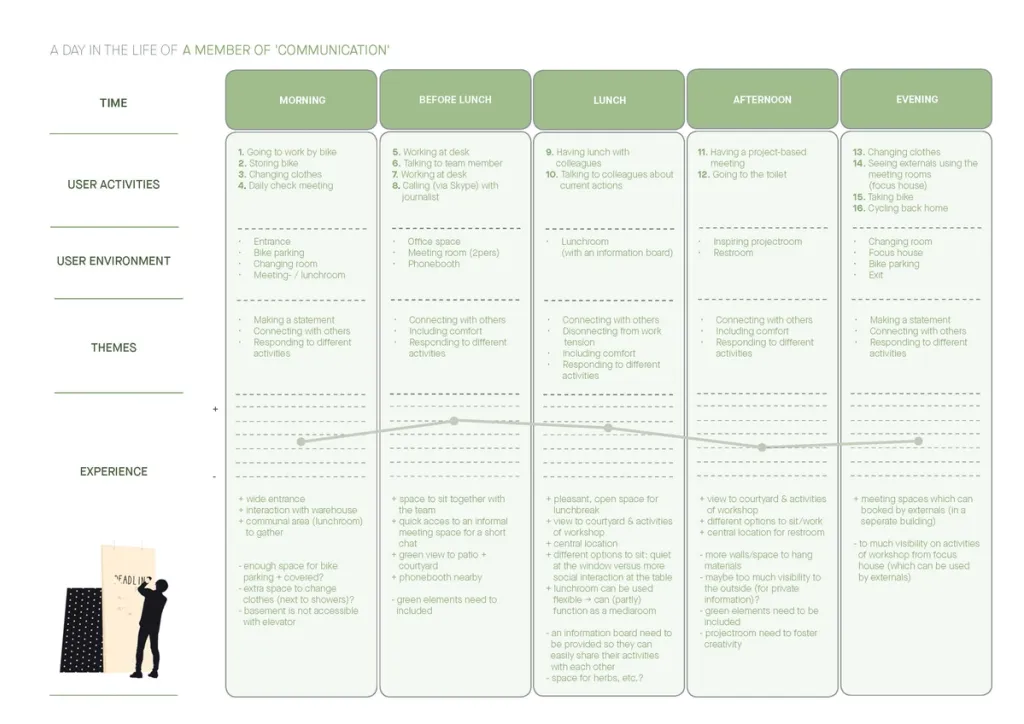
We translated these needs into personas and scenarios. Using customer journeys, we mapped how spaces responded to needs and optimised comfort, interaction and experience. Spaces were linked to concrete activities – focused work, creation, eating, meeting – and connected by a central courtyard. By sharing spaces with local organisations, a dynamic, inclusive working environment was created.
A customer journey from archipelago’s Scenario-Based Design Toolkit
Kerselaar: designing from emotions and daily routines
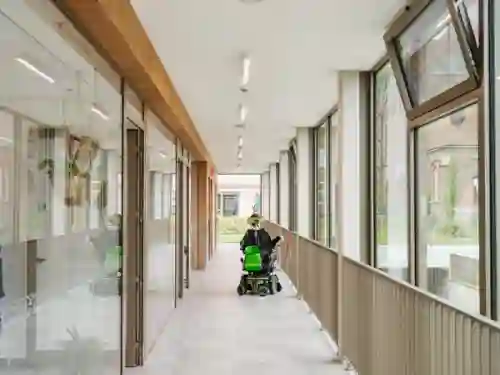
At Kerselaar in Overijse, a residence for people with physical and/or intellectual disabilities, we started from the lived experience and emotions of the residents.
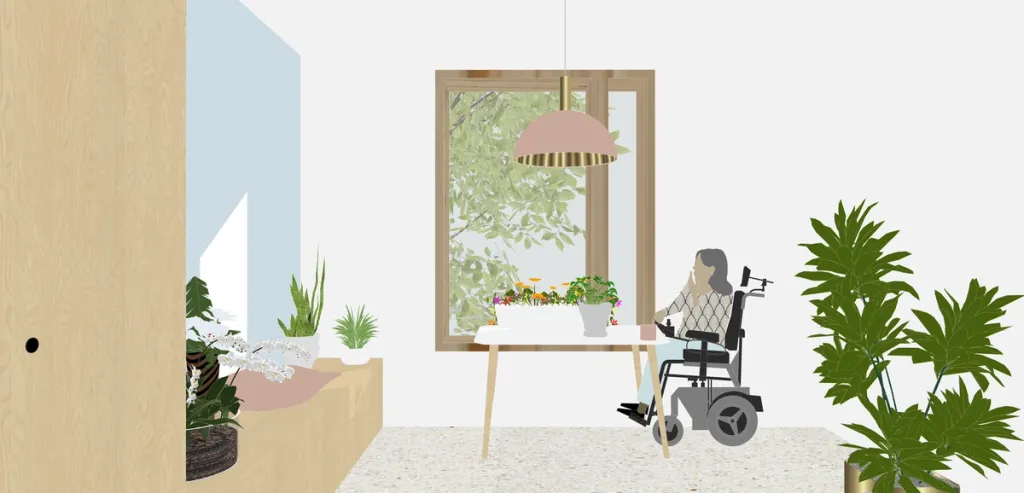
The personas ‘Jan’ and ‘Linda’ became a guiding thread, with the room as the basic building block: a space with discreet care and hoists for Linda, and a flexible yet orderly layout for Jan, with a clear day–night distinction. We let personas follow a route that maps rhythm, daily structure and rituals, and translate this spatially. By giving residents an active role, the ultimate goal – a home where they can take on responsibilities – was achieved. The method stimulates creative and reflective thinking and provides a reference framework for (re)evaluating decisions.
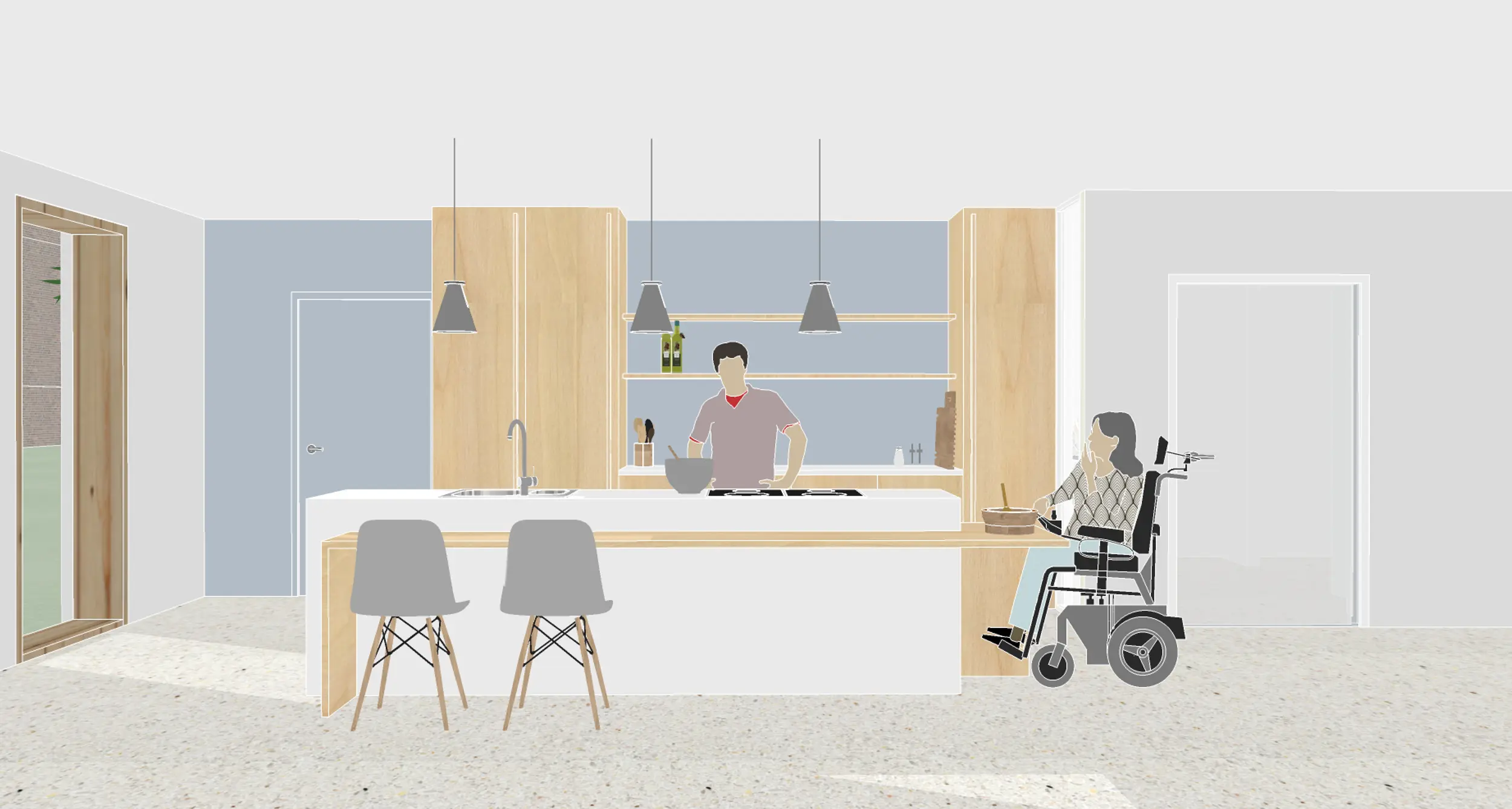
Linda, a persona from Kerselaar who, in this scenario, enjoys spending time looking outside and tending to plants in her room.
Design competition for Montgomery Police Station in Brussels: the balance between activation and recovery
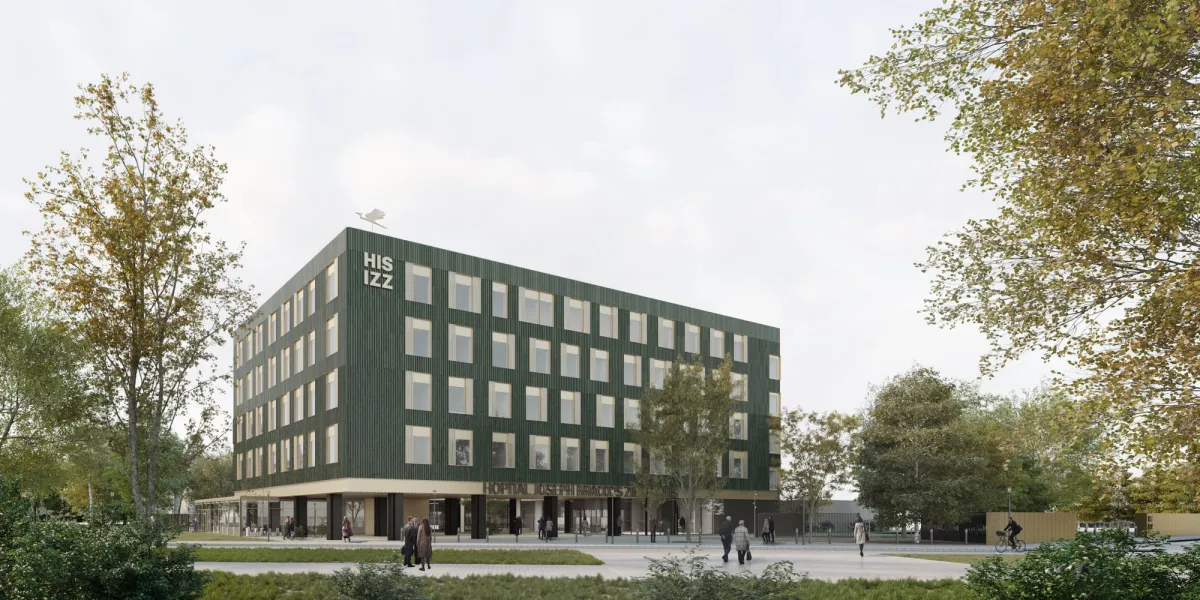
We investigated user needs through literature studies and interviews with police officers. Police work turned out to be driven by strong social engagement, with identity, responsibility and ‘pride in the job’ at its core. Safety is a fundamental prerequisite: overview, visibility and controlled access support a sense of security and the operational functioning of a police station. At the same time, there was a need for connection with colleagues and other services, combined with moments of disconnection and mental recovery. Comfort, contact with nature and movement are important supporting factors. These insights were translated into the personas ‘Kevin’ and ‘Julie’, which guided design decisions. The result is a police station that not only activates but also offers room for decompression and recovery.
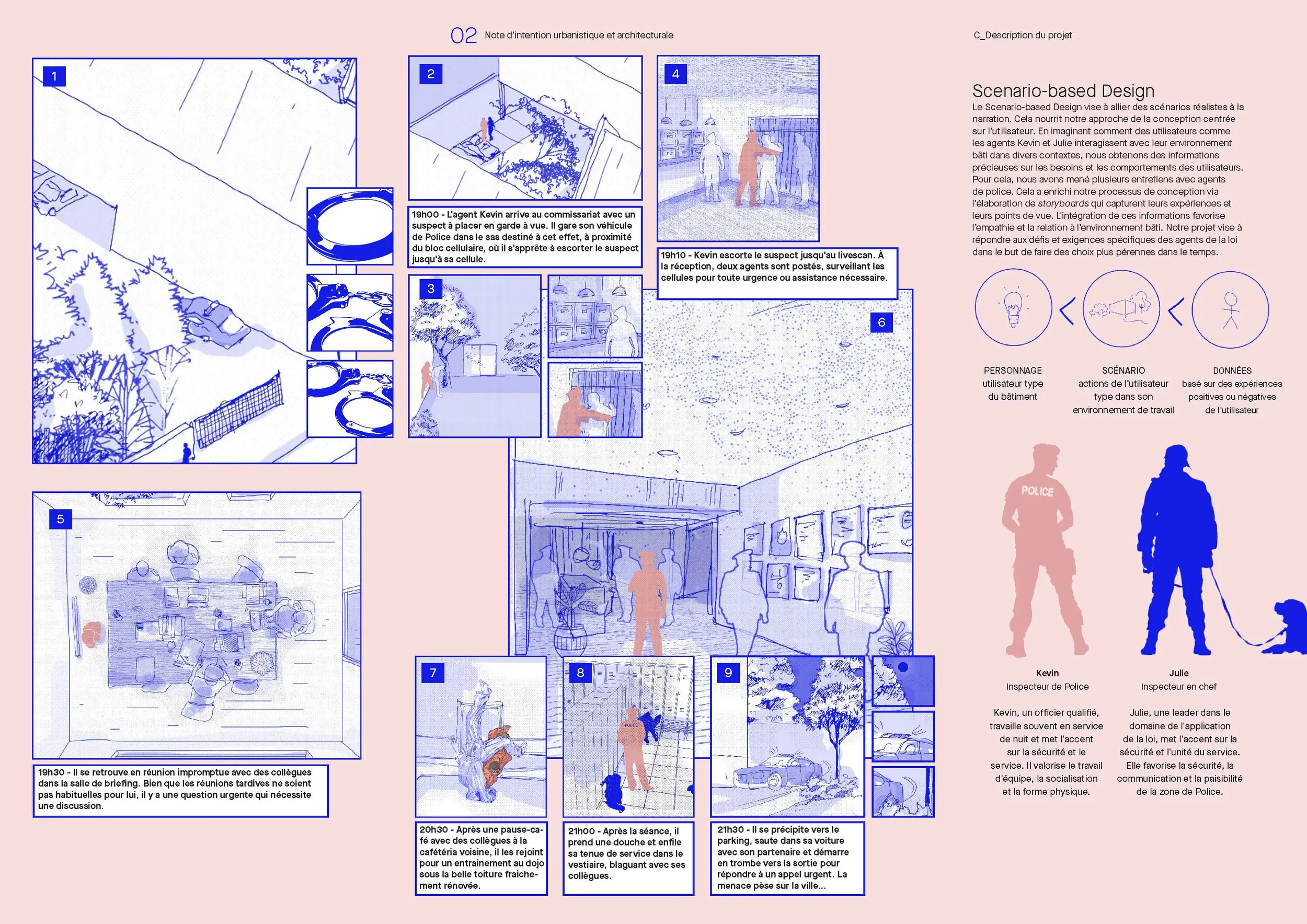
Scenario Based Design keeps the end user at the centre of the entire design process by translating routines, emotions and needs into a spatial, testable frame of reference. In projects such as HQ Greenpeace, De Kerselaar and the Montgomery police station, hidden needs thus become visible and environments emerge that support comfort, connection, safety and recovery.
Related projects & research
- Residential
- Mixed-use
- Masterplan
- Residential